History
Kumano Idehayao Jinja stands at the summit of Mt. Minakami (659 meters), a mountain rising southeast of Matsushiro in Nagano City. Shrine tradition dates its founding to 718, during the Nara period, when Idehayao no Mikoto was first enshrined here; the shrine marked its 1,300th anniversary in 2018. Idehayao no Mikoto is traditionally regarded as a son of the great deity of Suwa (Takeminakata) and has long been worshipped as the ancestral pioneer who opened this region to settlement, as well as a god of agriculture.
From the medieval period onward, Mt. Minakami flourished as a major sacred site of Kumano-lineage Shugendo, the mountain ascetic tradition, after a divided spirit of the Kumano deities was invited here — giving rise to its name at the time, “Kumano Sansha Dai-Gongen.” Mountain ascetics (yamabushi) undertook rigorous training on the slopes, and traces of that history remain in the area today. Following the Meiji-era edict separating Shinto and Buddhism, the ascetics were forced to return to secular life, and the shrine took its present name, Kumano Idehayao Jinja. Locally, the summit shrine is grouped together with subsidiary shrines on the grounds — including Jiju Jinja, which fronts the approach — under the collective name “Minakami Jinja.”
Jiju Jinja enshrines Jiju Okami. According to tradition, this deity was born as the third son of Uchiyama Mitsuaki, lord of Uchiyama Castle in Saku, Shinano Province, and trained as a mountain ascetic on Mt. Minakami. At his death by self-mummification (nyujo) in 1556, he is said to have declared three times that he was a manifestation of Fudo Myoo. He is worshipped as a guardian of child-rearing, longevity, and protection from fire, and local tradition holds that a child apprenticed to him will grow up free of illness — a belief that still brings families to the shrine soon after a birth.
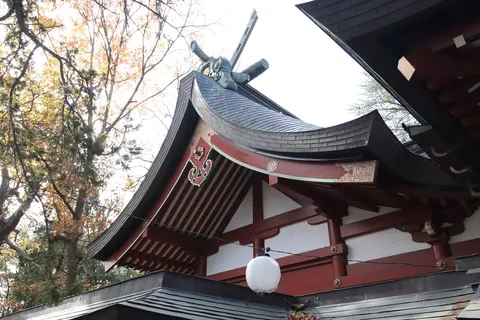
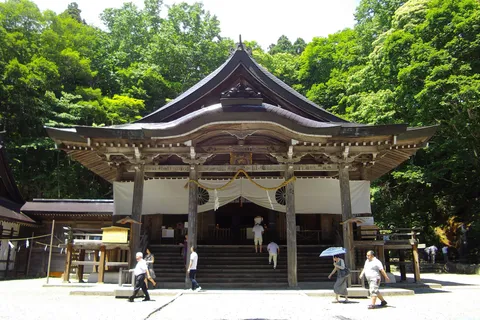
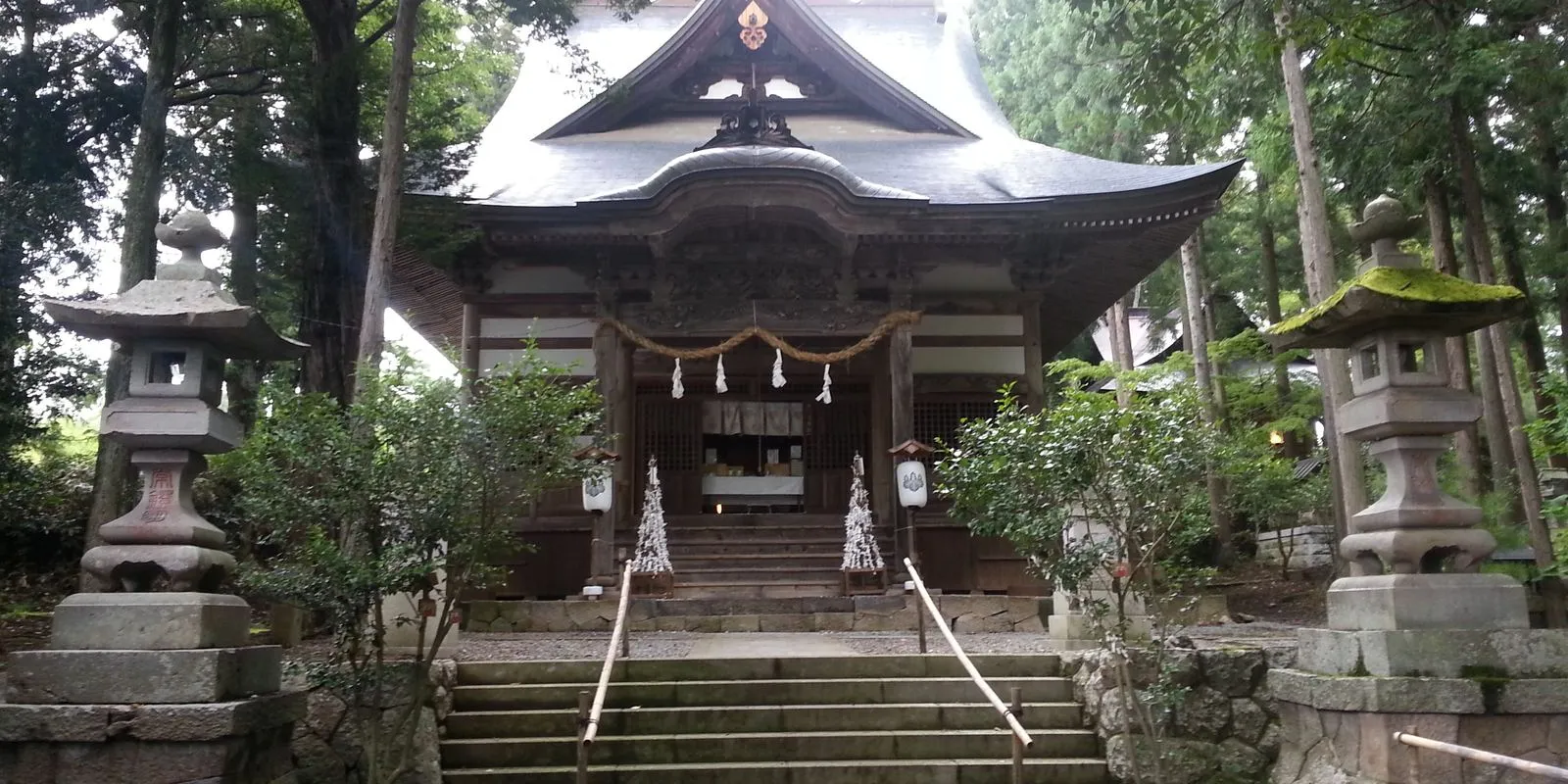
The current main hall is said to have been rebuilt in 1389 and was designated a Nagano Prefectural cultural property on August 15, 1994, a rare surviving structure connected to the mountain’s history of Shugendo practice.
Highlights
Mt. Minakami’s most distinctive feature is its unusually cone-shaped profile, which stands apart from the surrounding peaks. In the 1930s, this led Sakai Katsutoki — a Christian evangelist and occultist — to claim that ancient Japan had built artificial pyramids, with Mt. Minakami as one of them. His book on the subject was banned by the authorities of the era, and the theory has never been substantiated by mainstream scholarship; it survives today purely as a well-known, unverified legend, and signage on the mountain describing the enshrined deities in similarly speculative terms should be read the same way. Geological boring surveys tell a different story: Mt. Minakami is a natural andesite lava dome, formed by viscous lava that piled up near a vent roughly 300,000 to 350,000 years ago, with a lava layer some 150 meters thick — and no physical evidence of artificial construction. Partway up the slope sits Iwato Jinja, popularly rumored to be the pyramid’s “entrance.” It has no shrine building to speak of — only a rock cave with a sacred mirror enshrined inside — a simple, striking form of worship in its own right.
The mountain’s other defining event is real and well documented: the Matsushiro earthquake swarm, which began on August 3, 1965, and continued for roughly five and a half years. Its epicenters clustered directly beneath Mt. Minakami. More than 711,000 tremors were recorded, over 62,000 of them felt by residents. At the peak of the activity, the mountain itself rose by roughly one meter, an estimated 10 million cubic meters of groundwater surged to the surface, and a landslide in the Makiuchi district to the south destroyed 11 homes. The scientific consensus attributes the swarm to a “water-driven” mechanism — high-pressure groundwater fracturing the bedrock — rather than volcanic activity, and it remains a significant case study in seismology today. Unlike the pyramid legend, this is an observed and measured geological event.
Visiting Tips
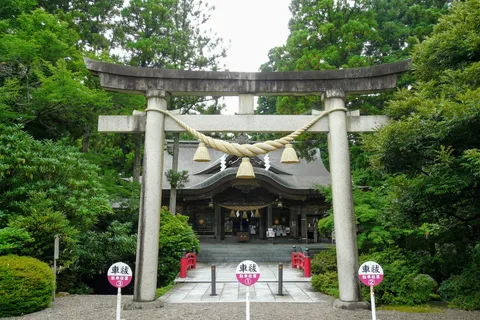
The grounds can be visited at any hour, but there is no priest stationed at the shrine office day to day, and goshuin are issued only as pre-written (kaki-oki) copies. A paved road leads most of the way up the mountain, with visitor parking beside the Zuishinmon gate near the summit — but the road is narrow, so walking up is not especially recommended, and drivers should watch carefully for oncoming traffic. The grounds themselves are modest in size, but the quiet mountaintop atmosphere and the view over the Matsushiro and Kawanakajima plains are well worth the trip.
Annual Festivals
- Nekooroshi Festival (January 4): A large shimenawa made from new straw and a wooden board bearing New Year’s wishes are set up at the shrine entrance, alongside rice-cake ornaments shaped like ripened ears of rice and miniature farming tools carved from sumac wood, all offered in prayer for a bountiful harvest.
- Hatsuho Festival, known as the Wheat Festival (July 28): Harvested wheat is purified with a mortar and pestle “seven and a half times” the night before, then steamed over sacred fire the next day and offered to the deity together with raw wheat, in thanks for a successful harvest.
- Nekomaki Festival (December 23): Marking the close of the year’s cycle of harvest prayers begun on January 4, a rice-cake “neko” is offered in a closing ceremony of thanks for the year’s agricultural abundance.
- Mt. Minakami Pyramid Festival (May 5): Organized by a local neighborhood committee rather than the shrine itself, this community event celebrates Mt. Minakami’s “world’s largest and oldest pyramid” legend every year on May 5 (Children’s Day), running from around 10:00 a.m. to 1:00 p.m.
Nearby Food & Sightseeing
- Matsushiro Castle Ruins: Said to have been built by Yamamoto Kansuke on the orders of Takeda Shingen, this castle later became the seat of the 100,000-koku Sanada domain. Now a nationally designated historic site, it lies at the heart of Matsushiro, about 15 minutes by car from Mt. Minakami.
- Sanada Residence: Built in 1864 by the ninth Matsushiro domain lord, Sanada Yukinori, as a retirement residence for his mother, this is the only surviving original building connected to Matsushiro Castle, located just next to the castle ruins.
- Matsushiro Underground Imperial Headquarters (Zozan Tunnels): Near the end of World War II, roughly 10 kilometers of tunnels were dug beneath Mt. Minakami, Mt. Maizuru, and Mt. Zozan to house a relocated wartime imperial headquarters. Only the Zozan tunnels are open to the public today — a striking reminder that Mt. Minakami’s history runs deeper than its legends and earthquakes alike.
Frequently Asked Questions
- Q. Who is enshrined at Kumano Idehayao Jinja, and what blessings is it known for?
- A. The principal deity, Idehayao no Mikoto, is traditionally regarded as a son of the great deity of Suwa and is worshipped as the ancestral pioneer of this region and a god of agriculture. Alongside him are four Kumano-lineage deities: Izanagi, Izanami, Hayatamao, and Kotosakao. The shrine is known for blessings of bountiful harvest and success in new ventures. A subsidiary shrine on the grounds, Jiju Jinja, enshrines Jiju Okami, worshipped as a guardian of child-rearing, longevity, and protection from fire; local tradition holds that a child "apprenticed" to this deity will grow up free of illness, and many families visit shortly after a child's birth.
- Q. Why is Mt. Minakami called a "pyramid"? Is there any truth to it?
- A. The claim traces to Sakai Katsutoki, a Christian evangelist and occultist active in the 1930s, who argued that ancient Japan once built artificial pyramids and identified Mt. Minakami's unusually cone-like shape as one of them. His book on the subject was banned by the authorities of the time, and the theory has never been substantiated by mainstream scholarship — it survives today as a well-known but unverified legend. Geological boring surveys have confirmed Mt. Minakami is a natural andesite lava dome that was active roughly 300,000 to 350,000 years ago, with no physical evidence of artificial construction.
- Q. What is the connection between the Matsushiro earthquake swarm and Mt. Minakami?
- A. The Matsushiro earthquake swarm was a real, extensively studied seismic event that lasted roughly five and a half years starting August 3, 1965, with its epicenters concentrated directly beneath Mt. Minakami. More than 711,000 tremors were recorded in total, over 62,000 of them felt by residents. At its peak the mountain rose by roughly one meter, an estimated 10 million cubic meters of groundwater surged to the surface, and a landslide in the Makiuchi district south of the mountain destroyed 11 homes. The established scientific explanation is a "water-driven" model, in which high-pressure groundwater fractured the bedrock — not volcanic activity, and entirely unrelated to the pyramid legend.
- Q. Is Kumano Idehayao Jinja an unstaffed shrine? Can you get a goshuin there?
- A. Being located at a mountain summit, this is not a shrine with a priest stationed at the office day to day, and goshuin are issued as pre-written (kaki-oki) copies rather than handwritten on the spot. Visitors should expect the shrine to be unstaffed much of the time and follow whatever signage is posted about goshuin availability. The grounds themselves can be visited at any hour.
- Q. How do I get to Kumano Idehayao Jinja, and is there parking?
- A. The address is 5464-2 Matsushiro-machi Toyosaka, Nagano, Nagano, about 30 minutes by car from the Nagano IC on the Joshin-etsu Expressway. A paved road runs most of the way to the summit, where visitor parking is available beside the Zuishinmon gate. The mountain road is narrow, so driving rather than walking is recommended. The grounds can be visited 24 hours a day.