History
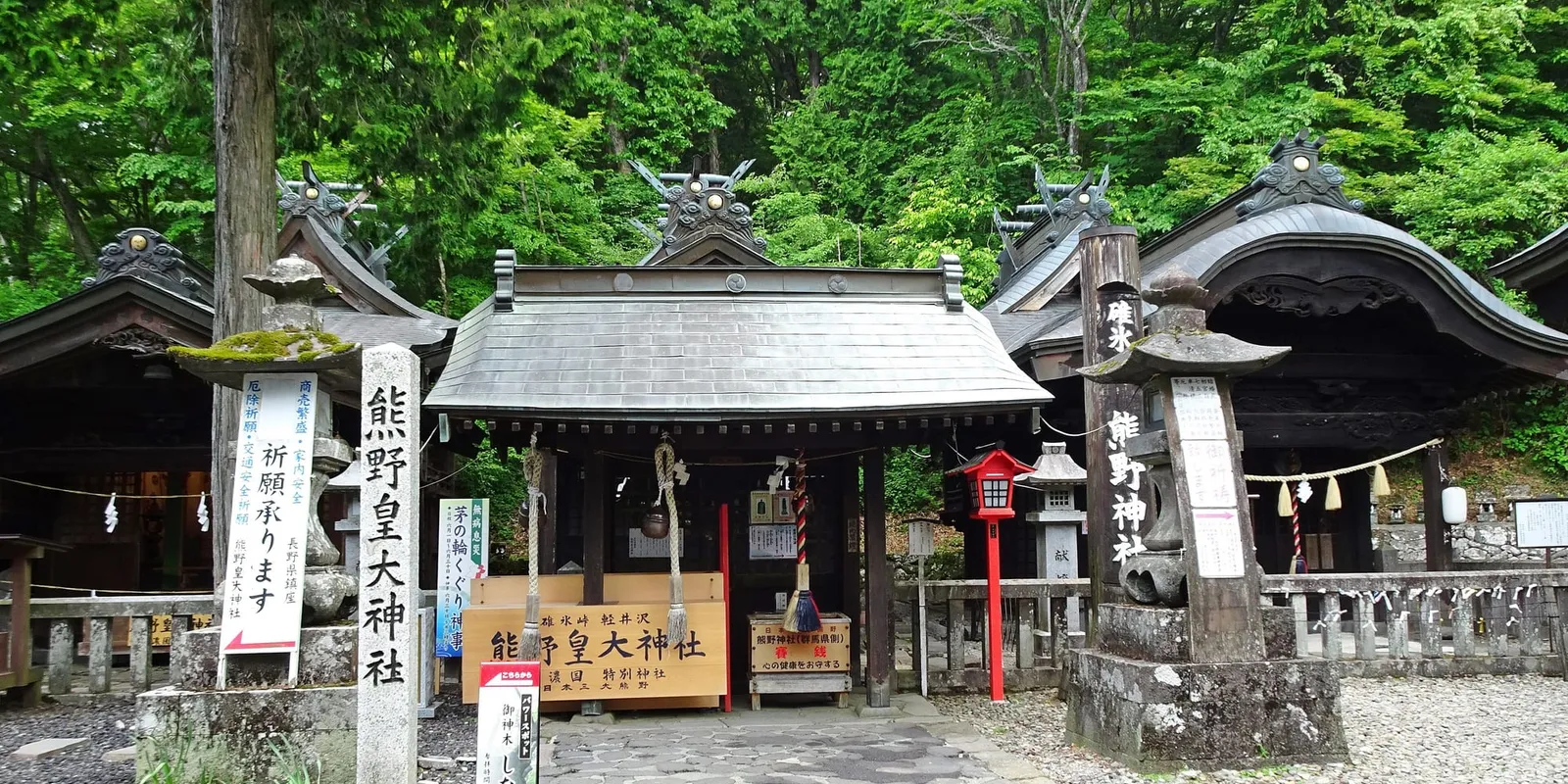
Kumano Kotai Jinja stands at the summit of Usui Pass in Karuizawa, Nagano, at an elevation of 1,200 m. The official site explains that the center of the shrine is divided between Nagano and Gunma prefectures, which is rare even in Japan. The reading “Kumano Kotai Jinja” is not given in the body text of the official site and comes from Japanese Wikipedia. The Gunma side is a separate corporation, “Kumano Jinja” (Annaka City): the official site says one shrine is divided into two religious corporations, and that each has its own chief priest, officers and representatives who maintain its dignity.
According to the official history, the shrine’s own records together with the Kojiki and Nihon Shoki place its founding in the 10th month of the 40th year of Emperor Keiko’s reign (110 CE), about 1,900 years ago. When Yamato Takeru crossed Usui Pass he was enveloped in deep fog, and met a single Yatagarasu crow that guided him, dropping leaves of the nagi tree as it went. He followed it and is said to have reached the summit safely. Because the Yatagarasu is also the bird that guided Emperor Jimmu from Kumano to Yamato, Yamato Takeru is said to have credited the protection of the Kumano deities and enshrined the three Kumano shrines in thanks. The official site also tells a legend that on his descent a gleaming snake guided him and later turned into a dragon and returned to heaven.
The official site also passes on stories of warlords. Minamoto no Yoritomo, troubled by long rain during a hunt at Asama, is said to have prayed here for fair weather and dedicated a kabura-ya (humming-bulb arrow). Nitta Yoshisada is said to have donated land as shrine territory from 新堀村鳥居坂 in Joshu in the east to 鳥井原村 in Saku District, Shinshu, in the west, putting up great torii at both ends. Sanada Yukimura is said to have prayed for victory here when he passed Usui Pass on his first battle. All of these are the shrine’s own accounts.
The official site says the shrine has been designated a “Special Shrine” by the Association of Shinto Shrines (one of only four in Japan: two Ontake Shrines, Fujisan Inari Shrine and Kumano Kotai Jinja). It also introduces itself as one of the “three great Kumano shrines of Japan.”
Highlights
The heart of the grounds is the sacred Shinano tree. The official site describes it as over 1,000 years old and says it is said to be the origin of the name of Shinano (sources differ). Its leaves are heart-shaped, and it bears many small white flowers around July. The Karuizawa town page says that the prefecturally designated cultural property “Toge no Shinano-ki” in the grounds is said to be over 800 years old, so the age figure differs from the official site. The official site also asks those who want to see the tree to pass through the shrine building.
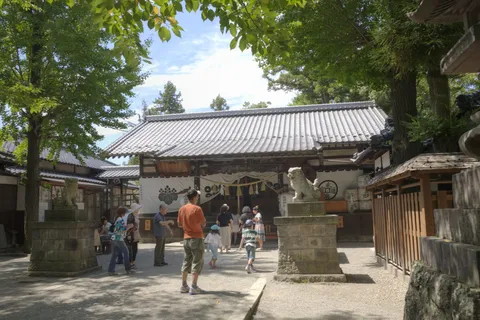
According to the official site, the enshrined deities are Izanami no Mikoto and Yamato Takeru no Mikoto in the main shrine that spans both prefectures, Hayatama no O no Mikoto in the Shingu on the Gunma side, and Amaterasu Omikami and Kotosaka no O no Mikoto in the Nachi shrine on the Nagano side. The official page for its dog-lovers’ association says that the oldest stone komainu (guardian dog) in Nagano stands here, made in the middle Muromachi period.
Goshuin come in many kinds. The official site shows a cut-out goshuin (Yatagarasu, Black) and a pop-up Shinano tree goshuin, both labeled “first in Japan”, as well as a prefectural-border seal and seasonal cut-out goshuin.
Visiting Tips
The official site gives 9:00 AM–4:00 PM as the visiting hours for the sacred tree. The Karuizawa town page lists “early April to late November”, and the official site does not say how winter is handled. Because this is a mountain pass at about 1,200 m, it is safest to check by phone (0267-42-5749) before you go. The official site says prayer services are by priority reservation, and asks that you apply by phone. The offering is from ¥6,000 for individuals and from ¥10,000 for companies, and the service is held in the 皇大殿 hall.
The offering amount and reception hours for goshuin are not stated on the official site. The official site lists special goshuin (a flower goshuin and a 烏牛王符 talisman) limited to the 1st and 15th of each month, and a Yatagarasu (Radiant) design limited to June and December.
The official site gives about 10 minutes by car from Karuizawa Station and about 5 minutes by car from Kyu-Karuizawa (about 45 minutes on foot), with local buses from in front of the Kyu-Karuizawa Kanko Kaikan. The number of parking spaces and fee are not stated on the official site, and large buses are asked to make an inquiry.
Annual Festivals
- Annual festivals (May 15 and October 15): According to Japanese Wikipedia. The shrine’s official site gives no schedule of annual events, so please check with the shrine before you go.
- Special goshuin (1st and 15th of each month): Per the official site, a flower goshuin and a 烏牛王符 talisman special goshuin are available only on the 1st and 15th of each month.
- Yatagarasu (Radiant) cut-out goshuin (June and December): The official site says “limited to June and December.”
- Shinano tree in bloom (around July): Per the official site, small white flowers bloom around July.
Nearby Food & Sightseeing
- Kyu-Usui Pass Observation Deck: According to the Karuizawa town page, it stands on the Nagano–Gunma border with views of the Joshu Three Mountains, the Nikko range, Mt. Asama and the Yatsugatake range. The same page carries a notice to carry bear bells or other noise-making items.
- Kyu-Karuizawa Suwa Shrine: A shrine linked from Kumano Kotai Jinja’s official site, described there as being near Kyu-Karuizawa Ginza.
Frequently Asked Questions
- Q. What are the visiting hours?
- A. The official site says visiting hours for the sacred Shinano tree are 9:00 AM–4:00 PM, and asks those who want to see the tree to pass through the shrine building. Phone reservations for prayer services and the like are also taken 9:00 AM–4:00 PM. The Karuizawa town page lists "early April to late November", but the official site gives no seasonal hours, so it is safest to ask the shrine beforehand in winter.
- Q. Can I get a goshuin at Kumano Kotai Jinja?
- A. The official goshuin page shows a shrine-name seal goshuin, a prefectural-border seal goshuin, cut-out goshuin (Yatagarasu), a pop-up Shinano tree goshuin, seasonal cut-out goshuin and more. Special goshuin (a flower goshuin and a 烏牛王符 talisman) are limited to the 1st and 15th of each month, and the Yatagarasu (Radiant) design is limited to June and December. The offering amount and reception hours are not stated on the official site, so please check with the shrine.
- Q. What does "a shrine on a prefectural border" mean?
- A. Per the official site, the shrine stands at the summit of Usui Pass (1,200 m above sea level), and the center of the shrine is divided between Nagano and Gunma prefectures. It is one shrine with two religious corporations: the Nagano side is Kumano Kotai Jinja and the Gunma side is Kumano Jinja, each with its own chief priest, officers and representatives who maintain its dignity. The Karuizawa town page likewise says the main hall straddles the border.
- Q. How do I get there, and is there parking?
- A. Per the official site, it is about 10 minutes by car from Karuizawa Station, about 5 minutes by car from Kyu-Karuizawa (about 45 minutes on foot), and about 30 minutes by car from the Usui-Karuizawa IC. Local buses run from in front of the Kyu-Karuizawa Kanko Kaikan. The Karuizawa town page gives 16 km and 35 minutes from the IC, or 15 minutes by taxi from Karuizawa Station. The official site gives no number of parking spaces or fee, and asks that large buses make an inquiry.
- Q. What is the sacred Shinano tree?
- A. The official site describes it as a sacred tree over 1,000 years old, said by some to be the origin of the name Shinano (Nagano's old province name; sources differ). Because the name carries the sense of "to bind", it has long been revered as a tree for good fortune and good relationships. Its leaves are heart-shaped and it bears many small white flowers around July. The Karuizawa town page describes the prefecturally designated cultural property "Toge no Shinano-ki" in the grounds as "said to be over 800 years old", so the age figure differs by source.
Plan Your Visit
Before you go, you can book a stay and get your shrine-visit items ready.
Amazon links open Amazon.co.jp (Japan) in English; whether an item ships overseas depends on the product.
※ Contains ads (PR). Links open external sites such as Amazon, Rakuten, Trip.com and Booking.com.