History
Musashi Jinja enshrines Miyamoto Musashi (c. 1584-1645), the early Edo-period swordsman renowned as the founder of Niten Ichi-ryu, a style of swordsmanship using two swords (originally called Nito Ichi-ryu, later renamed by his disciple Terao Kumanosuke Nobuyuki). Musashi is said to have gone undefeated through more than sixty duels over his lifetime, by his own account in his writings. The most famous of these took place in 1612, when Musashi was about 29, on the island of Funashima (now Ganryujima) off present-day Shimonoseki, where he defeated the rival swordsman Sasaki Kojiro. In his later years, Musashi was invited as a guest of Hosokawa Tadatoshi, lord of the Kumamoto domain, and retreated to the Reigando cave on Mount Kinpo, where he completed his treatise on strategy, The Book of Five Rings, before his death in Kumamoto on May 19, 1645. Following his will, he was buried in full armor along a highway so he could watch over the daimyo’s processions to Edo — a site that survives today as Musashizuka Park in Kumamoto.
Musashi’s birthplace remains a genuinely disputed question, with no definitive historical record settling it. The theory that he was born here, in Miyamoto, Mimasaka Province (present-day Miyamoto, Mimasaka City, Okayama), traces to the 1815 local gazetteer Tosakushi, and it became widely known nationwide after novelist Yoshikawa Eiji adopted the Mimasaka theory in his celebrated novel Musashi. Many historians, however, favor a rival claim that Musashi was born in Harima Province (present-day Hyogo Prefecture) — based chiefly on Musashi’s own opening line in The Book of Five Rings, which identifies his native province as Harima — with some pointing specifically to the Miyamoto area of Ibo District (present-day Taishi, Hyogo). Musashi Jinja was built out of the Mimasaka region’s affection for its claimed native swordsman, and should be understood as a shrine of tribute rather than a resolution of the birthplace controversy.
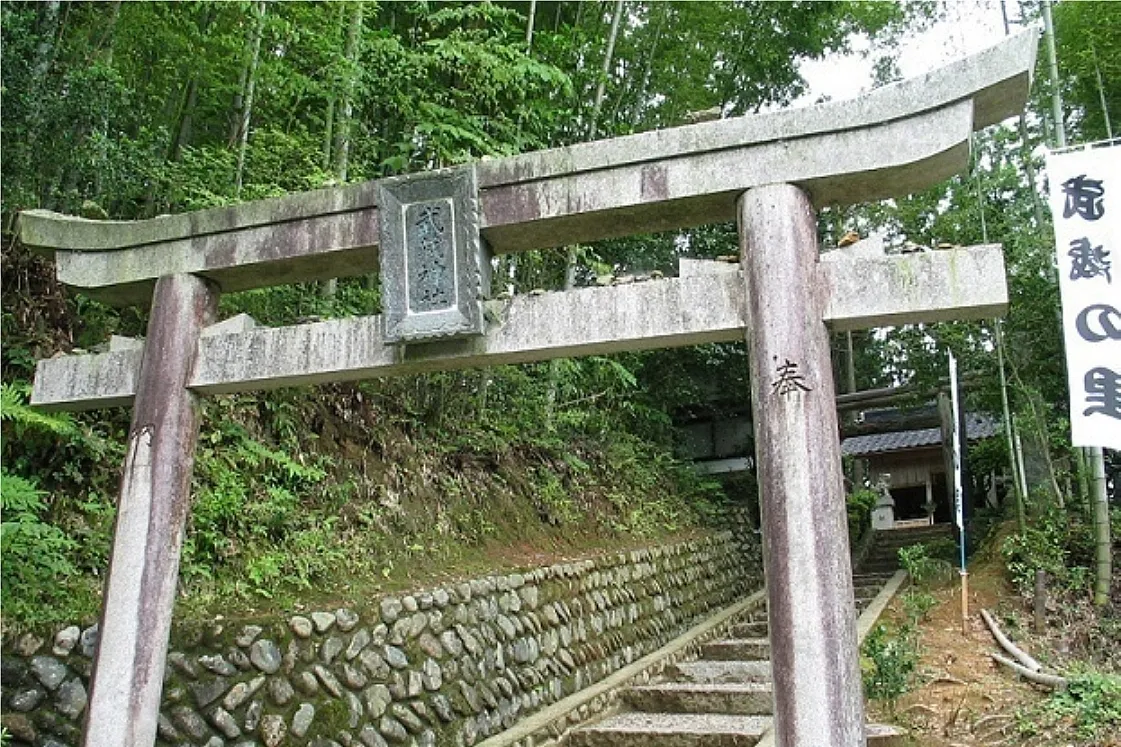
The shrine itself has a much more recent history. It was built in April 1971 through donations of 5.3 million yen from more than 1,300 supporters nationwide, organized through the Musashi Hosankai (Musashi Support Society), a group formed to honor Musashi’s memory. The shrine stands on a site known as Tenno-yama, about 200 meters up the old Inaba highway from the marker at Musashi’s traditional birthplace.
Notable Features
The wooden plaque reading “Musashi Jinja” above the entrance of the worship hall is attributed to Chomuki, said to be the founder of an engraved-calligraphy art form known as chosho geijutsu. In front of the shrine stands the “Senki no Hi” (Stone of Battle Spirit), inscribed with a line from a poem by the Tang-dynasty Chinese poet Bai Juyi, said to have been a favorite of Musashi’s: “Kanryu tsuki o obite sumu koto kagami no gotoshi” (“A cold stream wrapped in moonlight, clear as a mirror”).
Behind the shrine, a small burial ground holds the graves of Musashi’s grandfather, Hirata Shogen, and his parents, along with Musashi’s own memorial stone inscribed “Kenshoin Genshin Niten Koji: Miyamoto Masana Musashi no Hi,” said to hold remains divided from his grave in Kumamoto. Nearby stands a memorial tower dedicated to Sasaki Kojiro and the more than sixty other opponents Musashi is said to have faced in duels over his lifetime — a monument that today draws visits even from a French martial arts group practicing Niten Ichi-ryu in Gleize, France, a reminder of how far Musashi’s legacy has traveled.
A naturally heart-shaped stone set into the stone wall on the right side of the main hall has also made the shrine a modest “power spot” for visitors hoping for luck in romance.
Visiting Tips
Musashi Jinja is an unattended shrine — amulets, ema, and goshuin requests are handled not at the shrine itself but at the Musashi-no-Sato Ohara Tourist Information Center, a five-minute walk away, or at Takezo Chaya, the teahouse at the shrine’s entrance. Goshuin here follow an unusual mail-order system: rather than receiving one on the spot, visitors pay a fee at Takezo Chaya and the goshuin is mailed to their home afterward.
In honor of Musashi’s storied undefeated record, many visitors come here specifically to pray for victory ahead of a sports competition, or for success ahead of an entrance exam or job interview. The surrounding Musashi-no-Sato area also holds several other sites tied to Musashi’s life, including the ruins of his childhood home, making it easy to combine a visit to the shrine with a deeper look at his life story.
Annual Festivals
- Bamboo Sword Gratitude Festival (third Sunday of February): A ceremony, distinctive to Musashi Jinja, in which kendo practitioners ceremonially burn worn-out bamboo practice swords in gratitude.
- Miyamoto Musashi Festival: A local festival held in the Musashi-no-Sato area honoring Musashi’s memory; check with the Mimasaka City tourist information center for current dates.
Nearby Food & Sightseeing
Musashi Jinja sits within the “Musashi-no-Sato” area, a cluster of sites connected to Miyamoto Musashi’s traditionally claimed home region.
- Musashi-no-Sato Ohara Tourist Information Center: Handles amulet and ema requests for the shrine and provides local sightseeing information, along with displays of items connected to Musashi.
- Takezo Chaya: A teahouse at the shrine’s entrance known for its “Musashi two-sword udon,” served with two sets of utensils in a nod to his fighting style, and handles goshuin requests.
- Ruins of Musashi’s Childhood Home: The traditional site of the house where Musashi was said to have been born and raised, including a well said to have been used for his first bath as an infant.
Frequently Asked Questions
- Q. What kind of shrine is Musashi Jinja?
- A. Musashi Jinja enshrines Miyamoto Musashi, the legendary swordsman who authored The Book of Five Rings and founded the Niten Ichi-ryu school of two-sword combat. Built in 1971 with donations from admirers nationwide, on land traditionally said to be one of Musashi's birthplaces in Mimasaka, Okayama, it draws visitors praying for victory and exam success in honor of Musashi's storied undefeated record.
- Q. Was Musashi really born here?
- A. Mimasaka's Miyamoto area is one of the leading candidates for Musashi's birthplace, but no definitive historical record survives, and the question remains genuinely disputed among historians. The Mimasaka theory traces to the 1815 local gazetteer Tosakushi and became widely known after novelist Yoshikawa Eiji adopted it in his famous novel Musashi. A rival theory holds that Musashi was born in Harima Province (present-day Hyogo Prefecture), based largely on Musashi's own opening line in The Book of Five Rings identifying his native province as Harima. Musashi Jinja is best understood as a shrine honoring Musashi's memory on land tied to the Mimasaka tradition, not as settling the birthplace question.
- Q. Is this the same as Hachidai Jinja in Kyoto?
- A. No, they are different shrines. Hachidai Jinja in Kyoto's Sakyo Ward, founded in 1294, enshrines Susanoo, Inadahime, and Hachioji — Miyamoto Musashi is not one of its deities. It is famous instead for a bronze statue of Musashi and its proximity to the Ichijoji-sagarimatsu duel site, tied to the well-known story of Musashi passing the shrine before a duel. Musashi Jinja in Okayama is the only shrine that enshrines Musashi himself as a deity.
- Q. Can I receive a goshuin here?
- A. Yes, though the shrine itself is unattended. Requests are handled through the adjoining Takezo Chaya teahouse: pay ¥300 for the goshuin plus ¥100 postage (¥400 total), and it will be mailed to your home afterward rather than handed to you on the spot.
- Q. How do I get there?
- A. About a 20-minute walk from Miyamoto Musashi Station on the Chizu Express Line. By car, it's 5 minutes from Ohara IC on the Tottori Expressway or 20 minutes from Sayo IC on the Chugoku Expressway, with free parking near the shrine.
Related Shrines
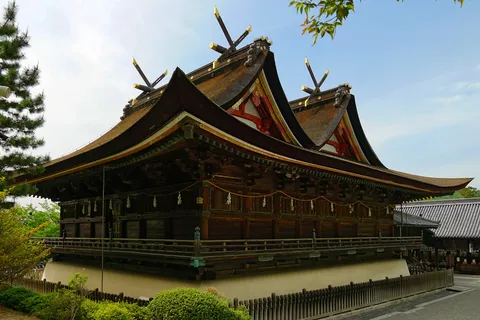
Okayama, Okayama (Kita-ku)
Kibitsu Jinja
Kibitsu-jinja
- Household Safety
- Business Prosperity
- Victory in Competition
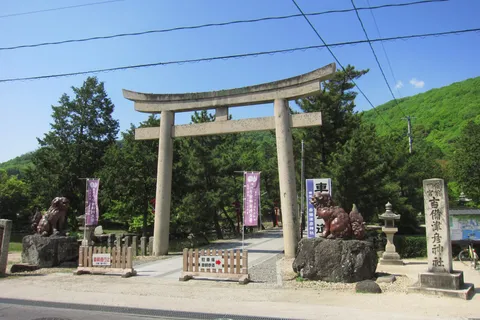
Okayama, Okayama (Kita-ku)
Kibitsuhiko Jinja
Kibitsuhiko-jinja
- Household Safety
- Victory in Competition
- Protection from Misfortune
Kanagawa Prefecture, Kamakura
Tsurugaoka Hachimangu
Tsurugaoka Hachiman-gū
- Victory in Competition
- Good Relationships
- Protection from Misfortune