History
Nakayama Jinja has long been venerated as the ichinomiya, or highest-ranked shrine, of former Mimasaka Province. Tradition places its founding in 707, though another well-supported theory holds that it was established around 713, when Mimasaka Province was carved out of six districts of Bizen Province, with a spirit invited here from Kibi-no-Nakayama in what is now Kita Ward, Okayama City. The shrine’s earliest confirmed appearance in the historical record comes in the Nihon Sandai Jitsuroku in 860, and the Engishiki shrine register of 927 lists it as the sole Myojin Taisha (great shrine) in all of Mimasaka Province — a status it held onto as the province’s ichinomiya for centuries afterward. In the medieval period, it appears in the Konjaku Monogatarishu as the home of a monkey deity, and it is named alongside Itsukushima Shrine in Aki and Kibitsu Shrine in Bitchu in the Ryojin Hisho, an anthology compiled under the retired emperor Go-Shirakawa — testimony to how widely known the shrine was at the time.
The primary deity is Kagamitsukuri no Kami (“the mirror-making deity”), enshrined together with Amenonukado no Kami and Ishikoridome no Kami. Ishikoridome no Kami is the deity credited in Japanese mythology with casting the sacred mirror (yata no kagami) used to help lure the sun goddess Amaterasu from the heavenly cave, linking this trio of deities closely with the casting and working of metal. When Nakayama Jinja was ranked a Kokuhei-chusha, a mid-level state-supported shrine, under the Meiji-era shrine ranking system in 1871, its enshrined deity was for a time officially registered as Kanayamahiko no Mikoto, a god associated with mining and metalworking, before further research led the shrine to revert to Kagamitsukuri no Kami as its principal deity after World War II. The Mimasaka region was historically known for tatara ironworking in the mountains of the Chugoku range, and Nakayama Jinja’s long association with metal-related deities is often discussed alongside that regional history of mining and iron production.
Highlights
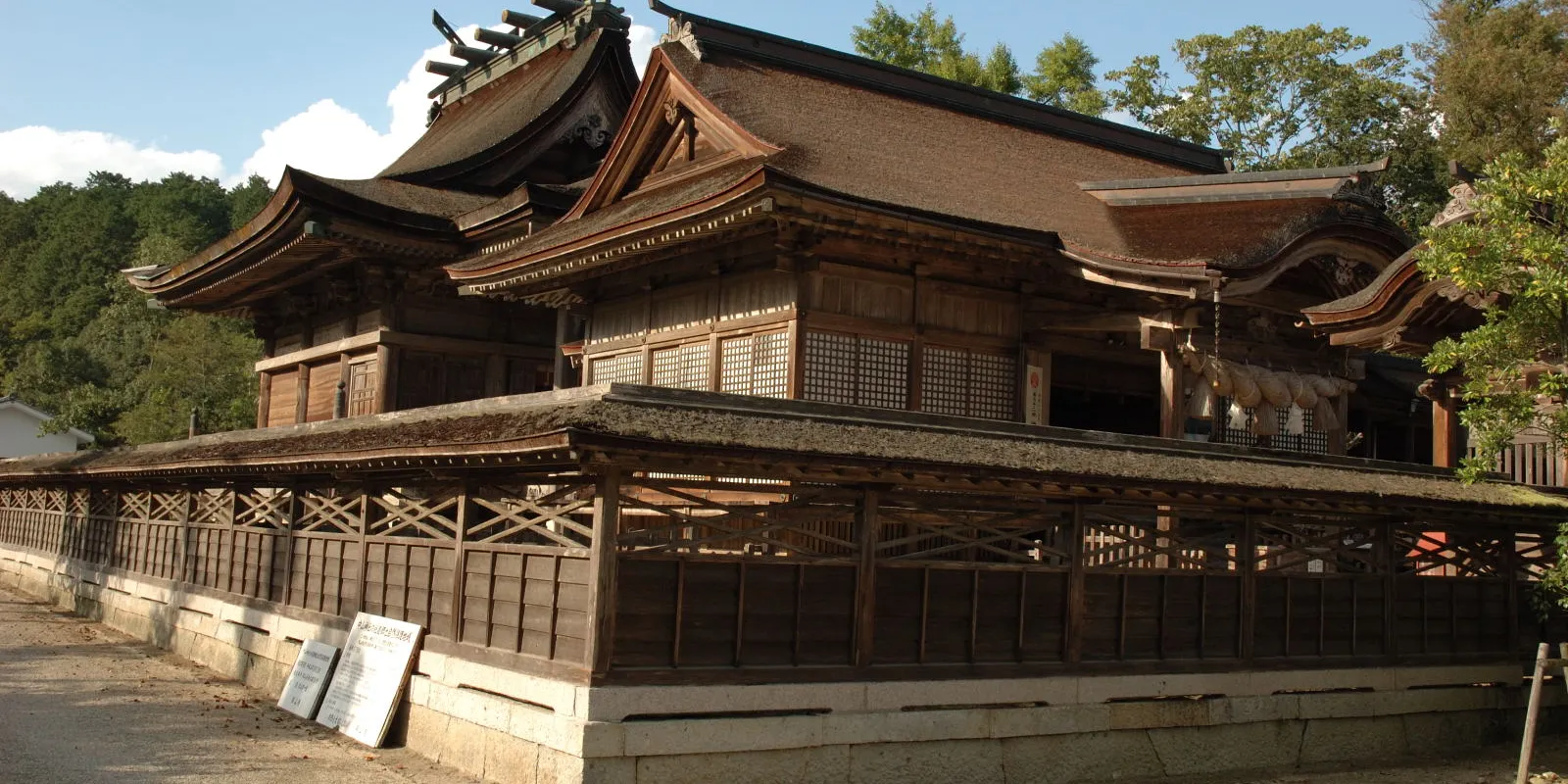
The single greatest highlight at Nakayama Jinja is its honden (main hall), rebuilt in 1559 with a donation from the deputy military governor Amago Haruhisa. Its three-by-three-bay irimoya structure, entered from the gable end and fronted by a one-bay curved karahafu canopy, is known as “Nakayama-zukuri,” a style found nowhere else in Japan outside this immediate area, and was designated a National Important Cultural Property in 1914. Among single shrine buildings nationwide, it ranks among the largest, and its broad cypress-bark roof gives it a dignified, imposing presence well worth seeing up close. The worship hall and offering hall, rebuilt in 1922 to coincide with repairs to the honden, share the same cypress-bark-roofed irimoya construction; valued for their curved karahafu canopy and coffered ceilings nearly as highly as the honden itself, they are separately listed on the national Register of Tangible Cultural Properties.
The shrine gate is a four-legged yakuimon-style gate relocated in the early Meiji era from the second bailey of Tsuyama Castle, and is itself designated a Tsuyama City cultural property. Rather than the usual pair of komainu lion-dogs, the grounds are watched over by statues of monkeys, said to recall a legend from the Konjaku Monogatarishu about the subjugation of a monkey deity. Several subsidiary shrines, including Saru-jinja (the “monkey shrine”), Soshinden, Kunishisha, and Misakisha, cluster within the grounds, reflecting the many layers of history behind Mimasaka’s ichinomiya. Nakayama-zukuri itself went on to shape the region’s shrine architecture more broadly, adopted for the honden of Mimasaka Soja-gu and Tsuruyama Hachiman-gu — both National Important Cultural Properties in Tsuyama — as well as Takano Jinja and Tokumori Jinja nearby.
Visiting Tips
The grounds can generally be visited 8:30–17:00, with prayer (kito) requests accepted 8:00–16:00. Goshuin are available for ¥500, hand-written to order at the shrine office between 9:00 and 17:00; since the priest sometimes serves other shrines and may be away, it’s worth calling ahead (0868-27-0051) if receiving one is important to your visit. The shrine sits in a quiet spot along the old Sakushu Kaido road, about 5–6 km north of central Tsuyama, and free parking for roughly 500 cars makes arriving by car the most convenient option. Those relying on public transport can take the Chutetsu Bus bound for Nishitabe from JR Tsuyama Station and get off at the Ichinomiya stop. Because the honden, worship hall, and offering hall are all nationally designated or registered cultural properties, please avoid touching the buildings when viewing them up close.
Annual Festivals
- Otaue Matsuri, Spring Grand Festival (April 29): A rite praying for a bountiful harvest. Around 10:30 a.m., following a ceremony in the main hall, a dozen or so parishioners dressed in white perform the motions of hoeing and planting seedlings across the shrine’s stone-paved grounds, symbolically treated as a rice paddy, while a pair of male and female shishi lions dance to flute and drum music. This long-transmitted agricultural rite draws large numbers of visitors from within and beyond the prefecture each year.
- Shinkosai, Autumn Grand Festival (November 3): An autumn festival centered on a sacred palanquin procession through the surrounding parish, one of the shrine’s largest annual events, supported by the whole local community.
- Oshimesai (December): A year-end rite said to originate in prayers offered at shrines and temples nationwide against the Mongol invasions of the Kamakura period.
Nearby Food & Sightseeing
- Honkoji Temple: An Obaku-sect Buddhist temple in the same Ichinomiya neighborhood as Nakayama Jinja, within easy walking distance. It’s known for a pair of roughly 300-year-old fragrant olive (mokusei) trees designated a Tsuyama City natural monument.
- Mimasaka Soja-gu: One of the “Three Great Shrines of Mimasaka” alongside Nakayama Jinja and Takano Jinja, enshrining the combined spirits of 912 shrines from 65 villages across the province. Its honden shares the same Nakayama-zukuri style as Nakayama Jinja’s and is likewise a National Important Cultural Property, making the two well worth comparing.
- Michi-no-Eki Kume-no-Sato: A roadside station selling local produce and Tsuyama specialties, with a farm-to-table restaurant serving dishes made from local ingredients — a good stop for a meal or souvenirs on the way to or from the shrine.
Frequently Asked Questions
- Q. Who is enshrined at Nakayama Jinja, and what blessings is it known for?
- A. The primary deity is Kagamitsukuri no Kami ("the mirror-making deity"), enshrined together with Amenonukado no Kami and Ishikoridome no Kami. Ishikoridome no Kami is credited in mythology with casting the sacred mirror used to lure the sun goddess Amaterasu from the heavenly cave, giving these deities a strong association with metal casting and metalworking. When the shrine was ranked a Kokuhei-chusha (mid-level state-supported shrine) in 1871, its main deity was for a time officially recorded as Kanayamahiko no Mikoto, a god of mining and metalworking, before the shrine's name for its deity was revised back to Kagamitsukuri no Kami after World War II. Reflecting this history, the shrine is known for blessings of industrial prosperity, for bountiful harvests tied to its April 29 rice-planting festival, and for protection from misfortune as the ichinomiya of Mimasaka Province.
- Q. What are the goshuin hours and fee at Nakayama Jinja?
- A. Goshuin are available for ¥500, hand-written to order at the shrine office between 9:00 and 17:00. Prayer requests are accepted 8:00–16:00. Since the priest sometimes serves other shrines as well and may be away, calling ahead (0868-27-0051) is a good idea if you want to be certain of receiving one.
- Q. How do I get to Nakayama Jinja, and is there parking?
- A. By car, it's about 15 minutes from JR Tsuyama Station or from Inshoji Interchange on the Chugoku Expressway. By public transport, take the Chutetsu Bus bound for Nishitabe from JR Tsuyama Station (about 20 minutes) and get off at the Ichinomiya stop. Free parking for roughly 500 cars is available on the grounds, making a visit by car especially convenient.
- Q. What is "Nakayama-zukuri," the architectural style associated with this shrine?
- A. Nakayama-zukuri is a distinctive honden (main hall) style found only among shrines in the Tsuyama area: a three-by-three-bay irimoya (hip-and-gable) structure entered from the gable end, with a one-bay curved karahafu canopy at the front. Nakayama Jinja's own honden is the style's defining example, rebuilt in 1559 with a donation from the deputy military governor Amago Haruhisa, and designated a National Important Cultural Property in 1914. The style was also adopted for the honden of Mimasaka Soja-gu and Tsuruyama Hachiman-gu (both National Important Cultural Properties) and other shrines such as Takano Jinja and Tokumori Jinja in the area, making Nakayama Jinja something of a regional architectural model. The worship hall and offering hall, rebuilt in 1922 in matching cypress-bark-roofed irimoya style, are separately listed on the national Register of Tangible Cultural Properties.
- Q. What is the Otaue Matsuri (rice-planting festival) held at Nakayama Jinja?
- A. Held every year on April 29 as the shrine's spring grand festival, this rite prays for a bountiful harvest. After a ceremony in the main hall around 10:30 a.m., the deity's spirit is moved to the middle gate, and a dozen or so parishioners dressed in white perform the motions of hoeing and planting seedlings on the shrine's stone-paved grounds, treated symbolically as a rice paddy, while a pair of male and female shishi lions dance to flute and drum music. An autumn grand festival centered on a sacred palanquin procession (Shinkosai) follows on November 3, and a December rite called Oshimesai — said to originate in prayers offered nationwide against the Mongol invasions of the Kamakura period — closes out the shrine's annual calendar.
Related Shrines
Okayama Prefecture, Kamo, Tsuyama
Samuhara Jinja Okunomiya
Samuhara Jinja Okunomiya
- Protection from Misfortune
- Good Health
- Longevity
Fukuoka, Soeda, Tagawa District
Hikosan Jingu
Hikosan Jingu
- Good Fortune
- Protection from Misfortune
- Household Safety
Miyagi, Shiogama
Okama Jinja
Okama Jinja
- Maritime Safety
- Industrial Prosperity
- Protection from Misfortune