History
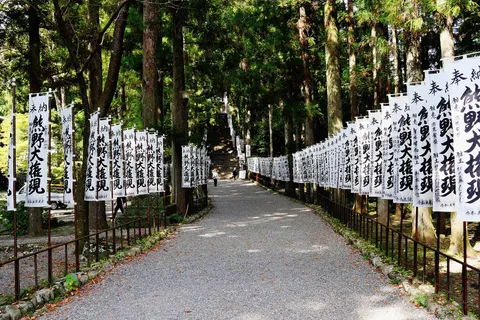
Niutsuhime Jinja is an ancient shrine set in the Amano basin, a mountain-ringed valley northwest of Koyasan, and is known as the guardian shrine of Mount Koya. Ranked as a Myojin Taisha in the Engishiki shrine register and as the Ichinomiya (chief shrine) of the old Kii Province, it is also regarded as the head shrine of roughly 180 shrines across Japan that enshrine the goddess Niutsuhime. The exact date of its founding is unknown, but the shrine itself tells of a history of more than 1,700 years. A fragment of the Harima no Kuni Fudoki records a goddess called “Nihotsuhime-no-mikoto” who, during Empress Jingu’s expedition to Korea, bestowed red earth and led the campaign to victory.
The principal deity, Niutsuhime-no-Okami (also called Niu Myojin), is said to be a goddess associated with cinnabar (mercury ore), the source of the vermilion pigment known as “tan”; some scholars instead see her as a water deity. The shrine reveres her as a goddess who wards off all calamities. The deity of the second hall, Takano-miko-no-Okami (Karibamyojin), is considered her child and is said to have guided Kobo Daishi (Kukai) to Koyasan. According to tradition, Kukai was led by this deity, who appeared as a hunter accompanied by two dogs, and was then granted the mountain land by Niutsuhime, who appeared in the form of a mountain dweller — the origin story of the founding of Koyasan. For this reason, the shrine still cherishes its “sacred dogs,” recalling the white and black dogs of the legend.
The third hall enshrines Ogetsuhime-no-Okami (Kehi Myojin), and the fourth hall Ichikishimahime-no-Okami (Itsukushima Myojin); together the four deities are known as the “Shosho Myojin” (the Four Myojin). These last two are said to have been invited from Kehi Jingu in Fukui Prefecture and Itsukushima Shrine in Hiroshima Prefecture in the early 13th century, in the early Kamakura period. The shrine is also said to have shown its divine power during the Mongol invasions, after which it received many donations from the court and the warrior class.
The four main halls (together with four inner shrine cabinets) and the Romon gate are designated Important Cultural Properties, and the grounds are a National Historic Site. In July 2004 the shrine was registered, together with the Kumano Sanzan and other sites, as part of the UNESCO World Heritage Site “Sacred Sites and Pilgrimage Routes in the Kii Mountain Range.” The registered components of the shrine itself are its main halls, Romon gate, and grounds, and the Choishi-michi, the main approach to Koyasan that runs along the ridge behind the shrine, belongs to the same World Heritage pilgrimage routes.
Highlights
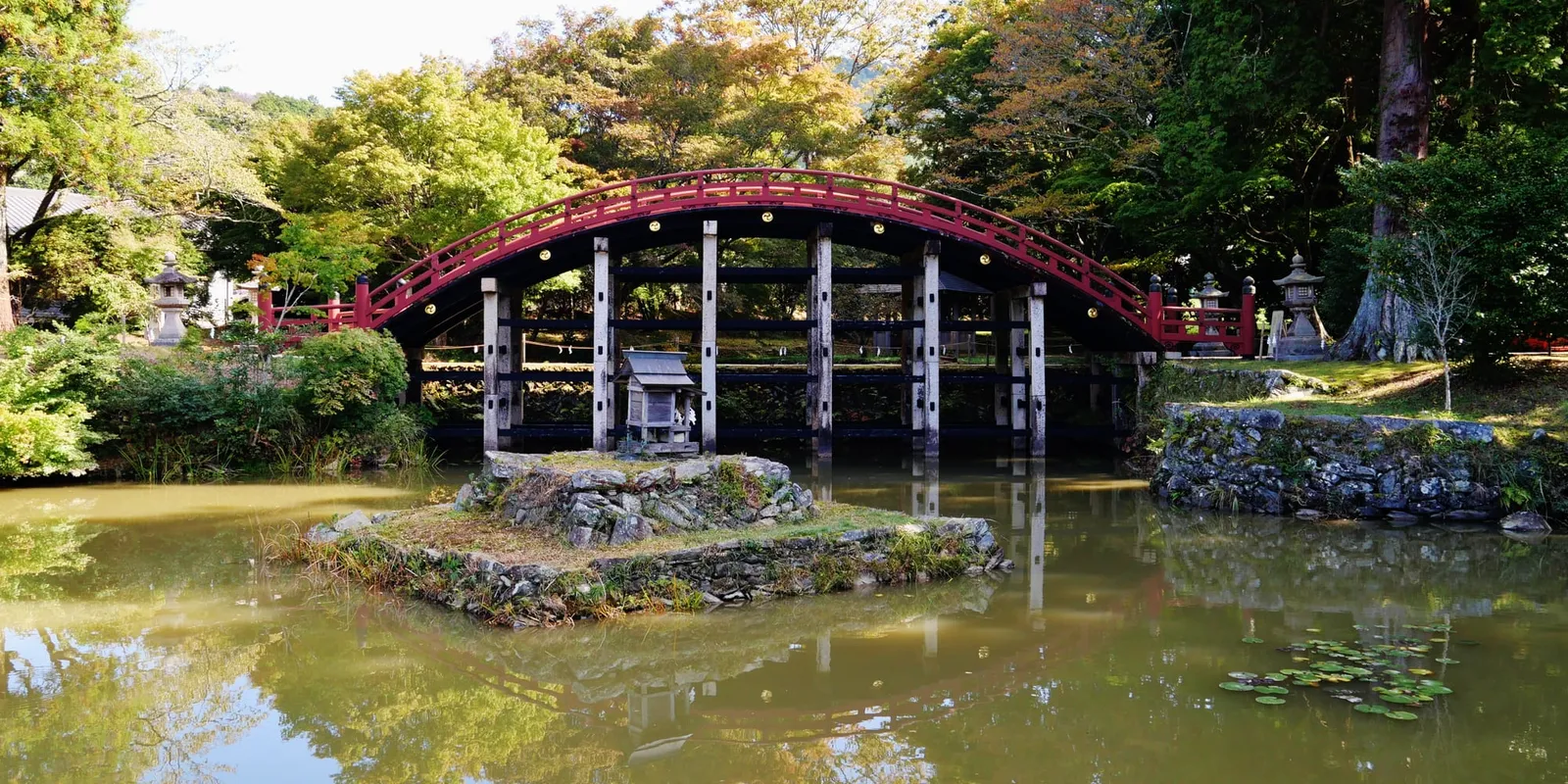
The first sight at the entrance is the vermilion arched bridge (known as the 輪橋, a drum-shaped bridge) crossing Kagami-ike pond. Tradition holds that it was built in the Keicho era (1596–1615) with a donation from Yodo-dono, a consort of Toyotomi Hideyoshi, and it is said to be the bridge the enshrined deities themselves cross. The view of the torii and shrine buildings beyond its sweeping arch is the shrine’s signature scene. On the nearby Misogi Bridge, purification implements and vermilion are said to be kept inside the ornamental finials, cleansing pilgrims as they cross.
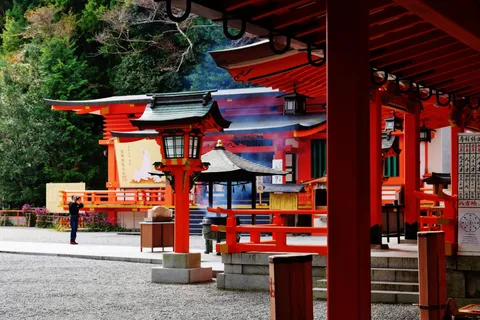
Beyond stands the Romon gate, a vermilion hip-and-gable gate with a cypress-bark roof, built in 1499 and designated an Important Cultural Property. Past the gate, the four main halls, from the first to the fourth, stand in a row; each is a one-bay Kasuga-style building with a cypress-bark roof, and each enshrines one deity. The halls were rebuilt at different times — two in the Muromachi period, one in 1715 and one in 1901 — and together they retain the character of a long history.
Among its treasures, the “Gindo Hirumaki Tachi-koshirae” (sword mounting with silver-gilt-copper spiral bands), dating to the late Heian period, is designated a National Treasure (it is on deposit at the Tokyo National Museum). Other Important Cultural Properties include Kamakura-period wooden komainu guardian lions, a gilt-bronze biwa lute, portable shrines, and swords.
On the 16th of each month, the day of the monthly festival, two Kishu dogs serving as the shrine’s sacred dogs (Suzuhime and Daiki) are shown to visitors (except in October; 10:00–11:30 and 13:00–14:30). The sacred-dog stamp is added to goshuin only on that day, which many visitors look forward to.
Visiting Tips
Niutsuhime Jinja sits among the hills of the Amano basin, about 30 minutes by Katsuragi Town community bus from the nearest station, JR Kasada. Buses run infrequently, so it is wise to check the timetable beforehand. By car, it is about 20 minutes from Katsuragi-Nishi IC on the Keinawa Expressway and about 30 minutes from Koyasan, with free parking available.
It is said to have been customary in the past to pay respects at Niutsuhime Jinja first before climbing Koyasan. If you walk the Choishi-michi, the main approach to Koyasan, a branch path (Hacchozaka) from the ridge behind the shrine leads down to it. Visiting the grounds is free.
Annual Festivals
- Onda-sai (third Sunday of January): An agricultural rite praying for a good harvest, in which a dance is offered followed by a variety of performing arts. It is designated an Intangible Folk Cultural Property of Wakayama Prefecture as the “Amano no Onda-sai.”
- Hanamori-sai (second Sunday of April): A festival celebrating the arrival of spring. In the afternoon, a mikoshi procession recreates the “Hamaori Shinji,” in which in medieval times the portable shrine was carried to Tamatsushima Shrine in Wakanoura.
- Nagoshi no Oharae (June 30): A purification rite for the first half of the year, held with a large “chinowa” grass ring to pass through.
- Reisai Grand Festival (October 16): The most important festival of the year, with prayers for the prosperity of the Imperial family and the nation, among others.
- Tsukinami-sai Monthly Festival (16th of each month): A morning ceremony held every month. On this day the sacred dogs are shown and the sacred-dog stamp is added to goshuin (except in October).
Nearby Food & Sightseeing
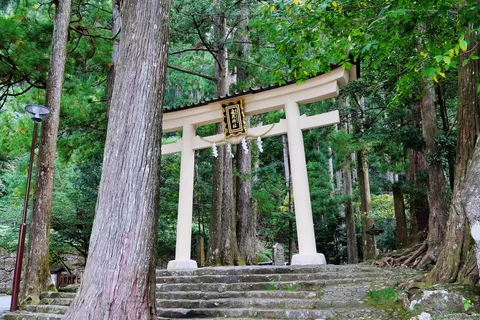
- Futatsu Torii (Koyasan Choishi-michi): A pair of torii standing at the junction where the branch path to Niutsuhime Jinja leaves the Choishi-michi, the main approach to Koyasan; it is part of the World Heritage pilgrimage routes. Pilgrims traditionally turned off here to pay their respects at the shrine before visiting Koyasan.
- Amano Nagomidokoro Cafe Kyakuden: A traditional-house cafe about a 3-minute walk from the shrine, serving meals made with rice grown in Amano. It is open only on certain days, so it is wise to check ahead.
- Amano no Sato Local Produce Shop “Yoyotte”: A farm-stand near the second parking lot selling locally grown vegetables, fruit, and rice. It is open mainly on Saturdays, Sundays, and public holidays.
Frequently Asked Questions
- Q. What are the visiting hours?
- A. The grounds can basically be visited at any time, and visiting is free. The shrine office (amulets and goshuin) is open 8:45–16:30, and prayer services are accepted 9:00–15:00.
- Q. When is the goshuin office open?
- A. 8:45–16:30 at the shrine office, with the goshuin either written directly in your book or provided pre-written. The fee is ¥500, and on the 16th of each month (monthly festival) a sacred-dog stamp is added.
- Q. Is there parking?
- A. Yes — two free lots (the first and second) hold about 60 cars in total, and a temporary lot also opens over the New Year period.
- Q. Why is it called the guardian shrine of Koyasan?
- A. According to tradition, the goddess Niutsuhime granted the sacred land of Koyasan to Kobo Daishi (Kukai) when he founded his monastery there. The shrine stands in the Amano basin, at the gateway to Koyasan.
- Q. How do I get there?
- A. About a 30-minute ride on the Katsuragi Town community bus (Amano course) from JR Kasada Station, getting off at the terminus "Niutsuhime Jinja". By car, it is about 20 minutes from Katsuragi-Nishi IC on the Keinawa Expressway.