History
Okunitama Jinja enshrines Okunitama no Okami, guardian deity of the old province of Musashi. This deity is identified with Okuninushi no Kami of Izumo, and tradition credits him with opening up the province in ancient times, teaching its people the arts of food, clothing, and shelter, and passing down medicine and protective rites — which is why he has long been worshipped as a god of fortune, good relationships, and protection from misfortune.
According to shrine legend, the shrine was founded on May 5 in the 41st year of Emperor Keiko’s reign (traditionally dated to 111 CE), by the god’s own oracle. A descendant of Ame-no-Hohi-no-Mikoto, ancestor of the Izumo clan, is said to have been appointed the first kuni no miyatsuko (provincial governor) of Musashi and to have served the shrine, an office passed down through generations. It’s worth noting that this founding date rests on shrine tradition rather than documented history.
The shrine’s better-documented turning point comes after the Taika Reform of 645. Once the provincial capital of Musashi was established on this site under Emperor Kotoku, the shrine became the ceremonial center of the provincial government, and to spare the governor the trouble of visiting every shrine in the province individually, the deities of its most prominent shrines were enshrined together here — the origin of its role as Musashi’s sōja, or “general shrine.” Later, the deities of Musashi’s First through Sixth Shrines (Ono, Ogawa, Hikawa, Chichibu, Kanasana, and Sugiyama) were enshrined on either side of the main hall, and the shrine came to be called “Rokusho-gu,” the Shrine of the Six.
During the Kamakura period, Minamoto no Yoritomo prayed here for Hojo Masako’s safe childbirth, and the shrine buildings were rebuilt in 1186 under the shogunate’s patronage. After entering Edo Castle in 1590, Tokugawa Ieyasu venerated the shrine deeply as Musashi’s sōja and granted it a 500-koku fief. Following a fire in 1646, the honden was rebuilt in 1667 by order of the fourth shogun, Tokugawa Ietsuna — the very building, a Tokyo Metropolitan Cultural Property, that stands today. In the Meiji era the shrine’s name reverted from “Musashi Sōja Rokusho-gu” to its original “Okunitama Jinja,” and it was ranked a state-supported shrine.
Highlights
The approach to the shrine runs beneath the Baba-Daimon zelkova avenue, said to have begun when the father-and-son warriors Minamoto no Yoriyoshi and Yoshiie, praying here for victory during the Former Nine Years’ War (1051–62), returned in triumph and donated a thousand zelkova saplings. Designated a National Place of Scenic Beauty and Natural Monument in December 1924, the avenue is a rare example of a keyaki-lined approach with this status, stretching roughly 700 meters north from the Zuijinmon gate.
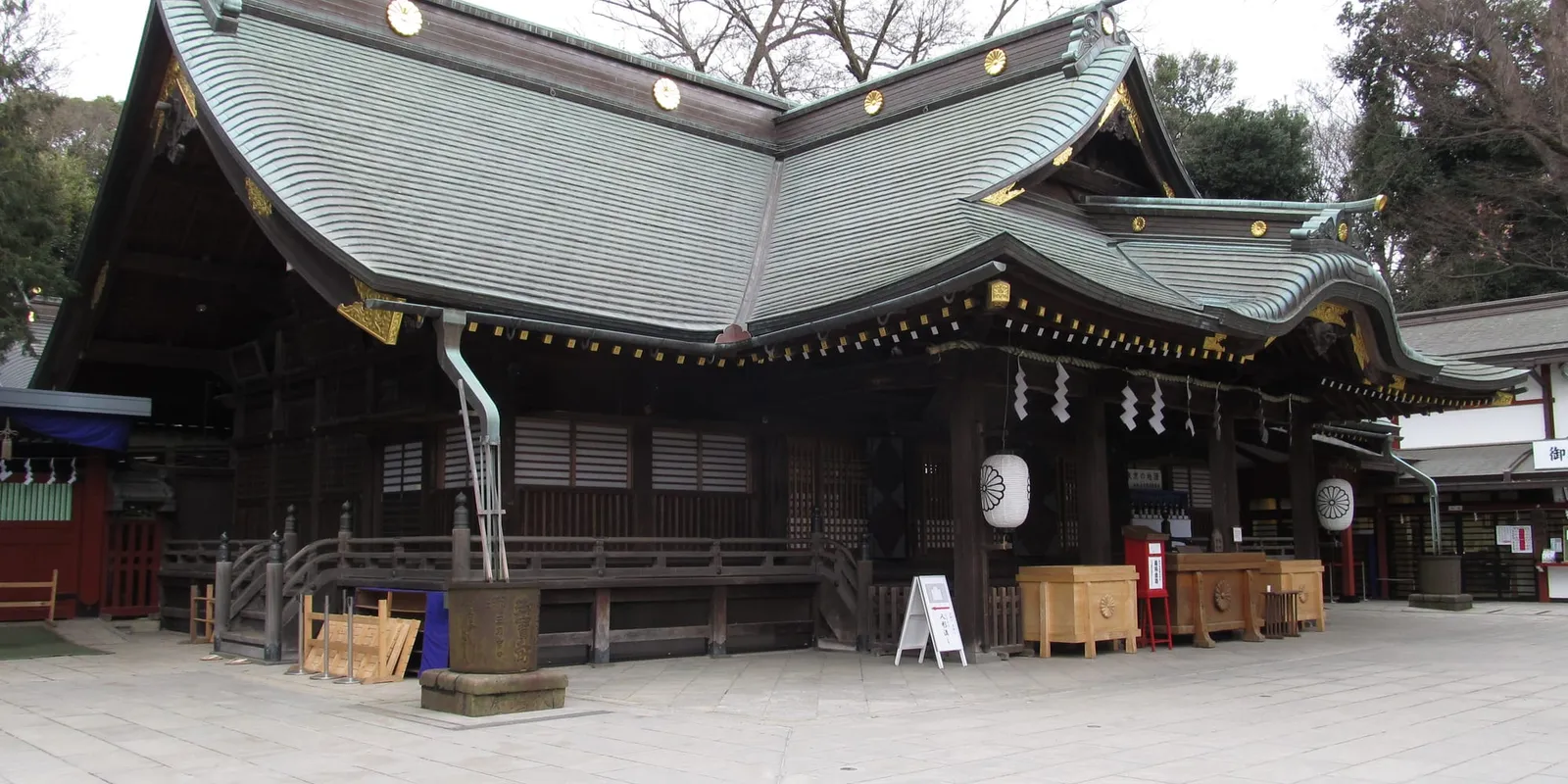
The honden, rebuilt in 1667, is a vermilion-lacquered structure of three shrines joined side by side and is a Tokyo Metropolitan Cultural Property. Beyond the Zuijinmon gate — rebuilt in 2011 for the shrine’s 1,900th anniversary — stands the imposing haiden (worship hall), rebuilt in 1885. The treasure hall houses the eight portable shrines used in the Kurayami Matsuri, one of Japan’s largest taiko drums, and Important Cultural Property komainu statues, and is open to the public on weekends, holidays, and festival days.
Visiting Tips
As Musashi Province’s sōja, the shrine enshrines the deities of its First through Sixth Shrines together, so a single visit is traditionally said to carry the blessings of paying respects at all of Musashi’s leading shrines at once. Several subsidiary shrines dot the grounds, including Miyanome Jinja (associated with safe childbirth), Toshogu, and Suijinja, and are worth visiting together with the main shrine. Prayer ceremonies are held daily from 9:00 to 16:00, and no reservation is needed.
Annual Festivals
- Kurayami Matsuri (April 30–May 6, main procession the evening and night of May 5): One of the three great “strange festivals” of the Kanto region, and a Tokyo Intangible Folk Cultural Property. Its name means “Festival of Darkness,” recalling the old custom of extinguishing the town’s lights so that eight mikoshi could be carried through the night to the shrine’s resting place. Today the procession, led by drummers and teams of bearers, still takes place on the evening of May 5 and remains the festival’s highlight, alongside events such as the Komakurabe horse race and a parade of festival floats throughout the week.
- Sumomo Matsuri (July 20): A midsummer tradition said to originate from Yoriyoshi and Yoshiie offering plums (sumomo) to the deity on their triumphant return; plum stalls fill the grounds.
- Autumn Festival / Kuri Matsuri (late September): A harvest thanksgiving festival with rows of paper lanterns lit across the grounds and torchlit kyogen and sacred dance performed at the kagura hall.
- Tori no Ichi (on the Day of the Rooster in November): A festival of the subsidiary Otori Jinja, drawing crowds of vendors selling decorative rakes for good fortune.
Nearby Food & Sightseeing
Beside the approach stands the city-run Furusato Fuchu History Museum, which introduces Fuchu’s history and culture free of charge. A short walk toward Fuchu-Honmachi Station leads to a quiet, hideaway café bathed in dappled light, perfect for a break between visits.
- Furusato Fuchu History Museum: A city-run history and culture museum beside the shrine’s approach, in front of city hall. Free admission, with a compact overview of Fuchu’s history.
- Koguma-ya Coffee: A hideaway café about 5 minutes’ walk from Fuchu-Honmachi Station and the shrine, with dappled light through the windows, hand-poured coffee, and homemade tarts.
Frequently Asked Questions
- Q. What are the visiting hours?
- A. The gates are open 6:00–17:00 from April 1 to September 14, and 6:30–17:00 from September 15 to March 31 (prayer reception 9:00–16:00).
- Q. Can I get a goshuin here?
- A. Yes, at the shrine office, 9:00–17:00, for ¥300.
- Q. How do I get there?
- A. It's a 5-minute walk from Fuchu Station on the Keio Line, or 5 minutes from Fuchu-Honmachi Station on the JR Nanbu/Musashino Lines. The approach runs along the famous Baba-Daimon zelkova avenue.
- Q. Is there parking?
- A. Yes, a 200-space paid parking lot on the grounds, open 24 hours.
- Q. What is the Kurayami Matsuri?
- A. It's the shrine's grand annual festival, held April 30–May 6 and centered on May 5. One of the three great 'strange festivals' of the Kanto region, it takes its name ('Festival of Darkness') from the old custom of extinguishing the town's lights so that eight sacred palanquins could be carried through the night to the shrine's resting place. It's designated a Tokyo Intangible Folk Cultural Property.