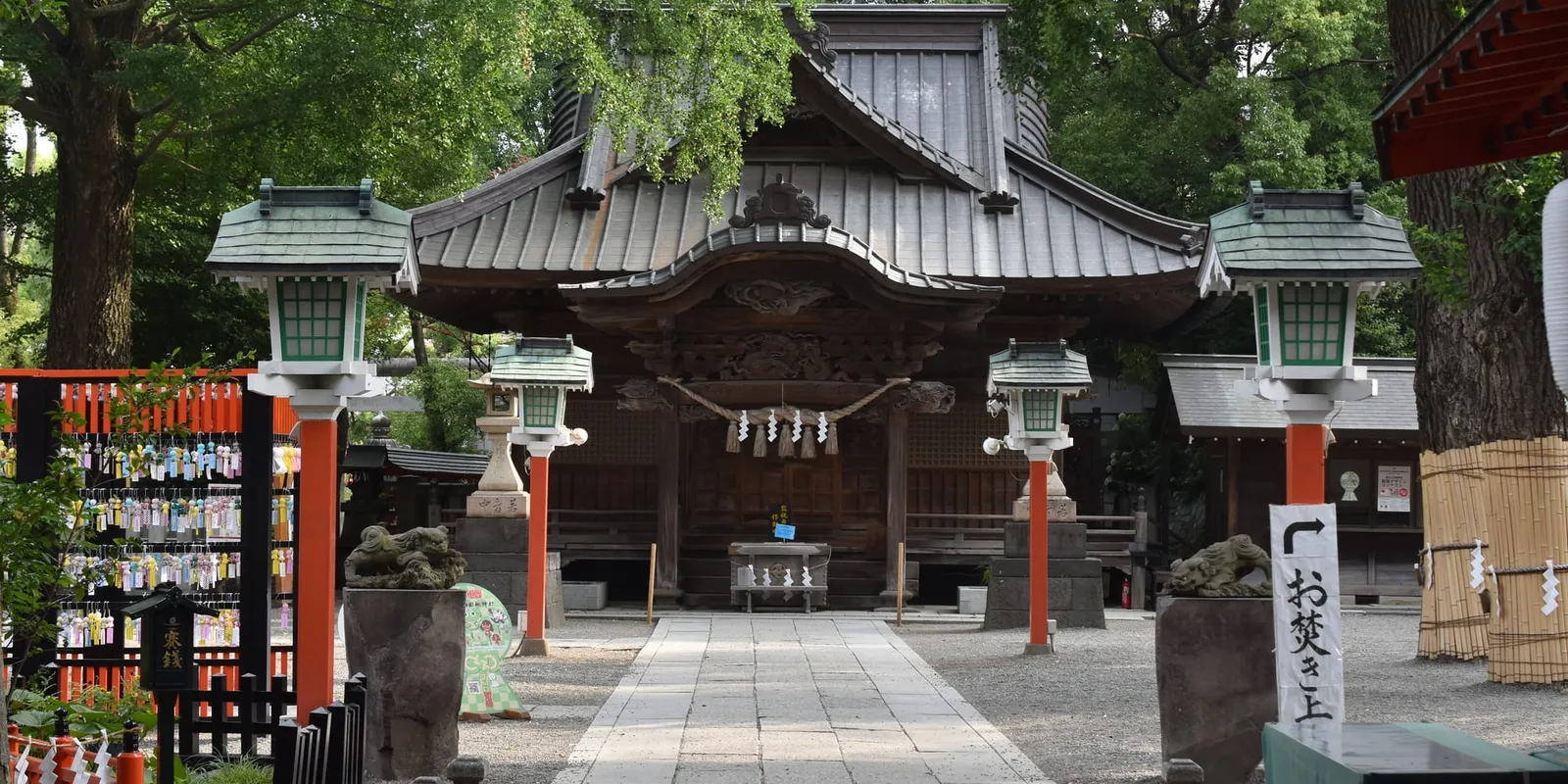
History
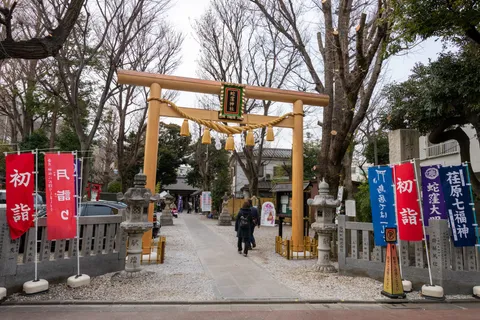
Tanashi Jinja’s founding is traditionally traced to the Shoo era (1288–1293), in the closing decades of the Kamakura period, when it stood on a hill called Yato-no-Miyayama, about a kilometer north of its present location. It was then known as “Jodono-daigongen,” enshrining a married pair of wind deities, Shinatsuhiko-no-Mikoto and Shinatobe-no-Mikoto, who together governed wind and rain.
During the Edo period, the Ome Kaido highway was built to transport lime — used in the plasterwork of Edo Castle’s ongoing construction — from the Ome region into the city. As the road brought new traffic and the local population resettled along it to form a thriving post town, the shrine moved together with its parishioners, arriving at its present site in Tanashi around 1670.
In 1872, under the Meiji government’s policy separating Shinto from Buddhism, the shrine was renamed Tanashi Jinja and began enshrining Okuninushi-no-Mikoto alongside its original wind deities. In 1910, five smaller neighborhood shrines scattered around Tanashi were merged into it, and in 1949 the deity of a former Otori Shrine was also transferred in. The shrine’s present main hall dates to 1858 and its worship hall to 1875, both featuring intricate woodcarving by the late-Edo-period master craftsman Shimamura Shunpyo — work recognized today as a Tokyo Metropolitan Tangible Cultural Property.
The Five Dragon Gods
What has made Tanashi Jinja famous nationwide is its enshrinement of five dragon deities — the “Goryujin,” or Five Dragon Gods — arranged according to Wu Xing, the ancient Chinese cosmology of the Five Elements. The shrine’s central deity, Jodono-daigongen in the main hall, is honored as the Golden Dragon at the center of the scheme, while four more dragons, each a different color, stand guard over the cardinal directions. Very few shrines anywhere in Japan enshrine all five of these directional dragons together, and visitors travel from across the country to seek out the specific dragon whose domain matches their own wish.
- Golden Dragon (Kinryujin) — Center, main hall. Representing the element Earth at the center of the Wu Xing scheme, the Golden Dragon is associated with good fortune and overall prosperity, and stands as the heart of the Five Dragon Gods.
- Blue Dragon (Seiryujin) — East. Guardian of the element Wood and the eastern direction, associated with advancement in skills, scholarship, and the arts, as well as career and employment success.
- Red Dragon (Sekiryujin) — South. Guardian of the element Fire and the southern direction, associated with victory in competition and achieving one’s goals — a favorite of visitors seeking success in exams, sports, or business.
- White Dragon (Hakuryujin) — West. Guardian of the element Metal and the western direction, associated with financial fortune and fulfilling relationships, drawing many visitors hoping for good romantic matches.
- Black Dragon (Kokuryujin) — North. Guardian of the element Water and the northern direction, associated with health and household safety.
Each dragon is represented by its own carved dragon statue or subsidiary shrine placed at the corresponding point on the grounds, so visitors can walk the full circuit and pray before each one in turn, matching their own wish to the dragon best suited to grant it. The shrine also sells goshuin, charms, and fortune slips themed around the Five Dragon Gods, with the colorful kirie (cut-paper) goshuin a particular favorite among visitors.
Highlights
The intricately carved dragon reliefs decorating the worship hall, the work of the celebrated Meiji-era sculptor Shimamura Shunpyo, are a highlight in their own right — their dynamic, lifelike detail rewards a close look. Tracing the shrine grounds to find each of the five dragon shrines is itself part of the appeal of visiting Tanashi Jinja.
In summer, the shrine is decorated with the “Tanabata Teruteru Tunnel,” a colorful seasonal installation of Tanabata streamers and teru-teru-bozu charms that draws many visitors and photographers. The grounds are also shaded by mature zelkova and ginkgo trees — one of the ginkgoes is a designated natural monument of Nishitokyo City — offering a surprisingly green setting for a shrine in the middle of the Tokyo suburbs.
Visiting Tips
The shrine grounds are open at all times, but the office for goshuin and amulets accepts visitors only 9:00–17:00, so it’s worth allowing enough time if that’s part of your plan. Since the five dragon shrines are spread across the grounds in a rough circuit around the main hall, visiting all five involves a fair bit of walking — pick the dragon or two that match your own wish if you’re short on time, or take the full tour if you have it.
Access is convenient, just 6 minutes on foot from Tanashi Station on the Seibu Shinjuku Line, though the shrine gets very crowded during New Year’s and its annual festival. A weekday morning is the best time to visit if you prefer a quieter atmosphere.
Annual Festivals
- Reitaisai (Grand Festival, annually in October, over two days): Tanashi Jinja’s largest festival. On the eve festival (yoiya), a “Dragon God mikoshi” and a women’s mikoshi are carried through the streets of Tanashi; on the main festival day (honsai), the shrine’s principal mikoshi, a children’s mikoshi, and a great taiko drum take part. In 2026 the festival is scheduled for October 10 (Saturday, yoiya) and October 11 (Sunday, honsai).
- Ichiraku Mankai (November 23 – February 3): A Tanashi Jinja original rite praying for good fortune to open up one after another.
- Setsubun Festival (around February 3): A ritual to drive away misfortune and invite good luck.
- Tanabata Teruteru Tunnel (summer): A seasonal installation of colorful Tanabata decorations and teru-teru-bozu charms across the shrine grounds.
- New Year’s Visit (January): As a well-known power spot for the Five Dragon Gods, the shrine draws large crowds during the first three days of the New Year.
Nearby Food & Sightseeing
- Sky Tower Nishitokyo (“Tanashi Tower”): A 195m multipurpose radio tower within walking distance of Tanashi Jinja, affectionately nicknamed “Tanashi Tower.” Its nighttime illumination has become a landmark of western Tokyo.
- Musashino Sabo Tanashi (main shop): A well-regarded Japanese sweets and tea shop near Tanashi Station, a convenient stop for a break after visiting the shrine.
- Tama Rokuto Science Center: A science museum known for one of the world’s largest planetariums, a popular stop for visitors with children.
- Nishitokyo Ikoi-no-Mori Park: A spacious, green park ideal for a stroll or a rest with children.
Frequently Asked Questions
- Q. What are the visiting hours?
- A. The shrine grounds are open around the clock, with the hall doors opening around 8:00 and closing after 17:00. The office where you can receive amulets, charms, and goshuin is open 9:00–17:00, and prayer services are accepted 9:30–16:00.
- Q. Can I get a goshuin here?
- A. Yes, at the shrine office, open 9:00–17:00. The standard and monthly calligraphy styles are ¥500, limited designs such as the Five Dragon Gods or seasonal prints are also ¥500 each, and the colorful kirie (cut-paper) goshuin is ¥1,500.
- Q. How do I get to Tanashi Jinja?
- A. It's a 6-minute walk from the north exit of Tanashi Station on the Seibu Shinjuku Line. Bus connections are also available from JR Musashi-Sakai and Mitaka stations.
- Q. Is parking available?
- A. Yes, a two-level parking structure on the shrine's west side has about 50 free spaces, open 24 hours. The lower level has a 2.2m height restriction. The lot fills quickly during the New Year's period, so public transport is recommended at that time.
- Q. What are the Five Dragon Gods at Tanashi Jinja?
- A. Tanashi Jinja's single most distinctive feature is that it enshrines all five directional Dragon Gods of Wu Xing (Five Elements) cosmology together — something very few shrines in Japan do. The central Golden Dragon (in the main hall) grants good fortune, the Eastern Blue Dragon grants skill and career advancement, the Southern Red Dragon grants victory and success, the Western White Dragon grants financial luck and good relationships, and the Northern Black Dragon grants health and household safety.