History
Utsunomiya Futaarayama Jinja stands atop Mount Usugamine (about 130m in elevation), a hill rising near the very center of Utsunomiya, and its history is said to reach back to the reign of Japan’s tenth emperor, Sujin. According to shrine records, when the ancient region of Kenu was divided into the provinces of Kozuke and Shimotsuke during the reign of the sixteenth emperor, Nintoku, Narawake no Kimi — a fourth-generation descendant of the deity Toyokiirihiko no Mikoto — was appointed provincial governor of Shimotsuke and enshrined his ancestral deity at Araosaki, the site of what is now the shrine’s sub-shrine, Shimo-no-miya. The shrine was later relocated to its present site on Mount Usugamine in 838.
The Engishiki shrine registry, compiled in 927, records a “Futaarayama Jinja” as the sole Myojin Taisha (an elite category of shrine) of Kawachi District, Shimotsuke Province — the only shrine of this rank in what is now Tochigi Prefecture — and the shrine has long been venerated under names such as “Myojin-sama” and “Futaara-san.” During the Heian and Kamakura periods, the highest-ranked shrine in each province came to be called its ichinomiya, and this shrine was recognized as the ichinomiya of Shimotsuke Province; one theory holds that the place name “Utsunomiya” itself derives from a corruption of “ichinomiya.”
According to the Nihon Shoki, the enshrined deity Toyokiirihiko no Mikoto was the eldest son of Emperor Sujin. After losing out to his younger brother, Ikume no Mikoto (later Emperor Suinin), in a dream-divination over the imperial succession, he was sent from the Yamato court to guard the eastern provinces. He is credited with developing the ancient region of Kenu (present-day Tochigi and Gunma) and promoting the industries of daily life — food, clothing, and shelter — and has long been revered as the founding ancestral deity of Utsunomiya. Enshrined alongside him are two companion deities associated with the development of the land: Omononushi no Mikoto (worshipped as Daikokuten) and Kotoshironushi no Mikoto (worshipped as Ebisu).
Toyokiirihiko no Mikoto was also renowned for martial virtue, and the shrine drew deep devotion from generations of warlords who prayed here for victory: Fujiwara no Hidesato (during the rebellion of Taira no Masakado), Minamoto no Yoriyoshi and Yoshiie (during the Former and Later Nine Years’ Wars), Minamoto no Yoritomo (during the Genpei War), and Tokugawa Ieyasu (before the Battle of Sekigahara) all donated shrine lands and treasures or funded reconstruction of its buildings over the centuries. Despite its similar name, Nikko Futarasan Jinja in the city of Nikko is a separate shrine with a different enshrined deity and a different founding story (see the FAQ below for details).
Highlights
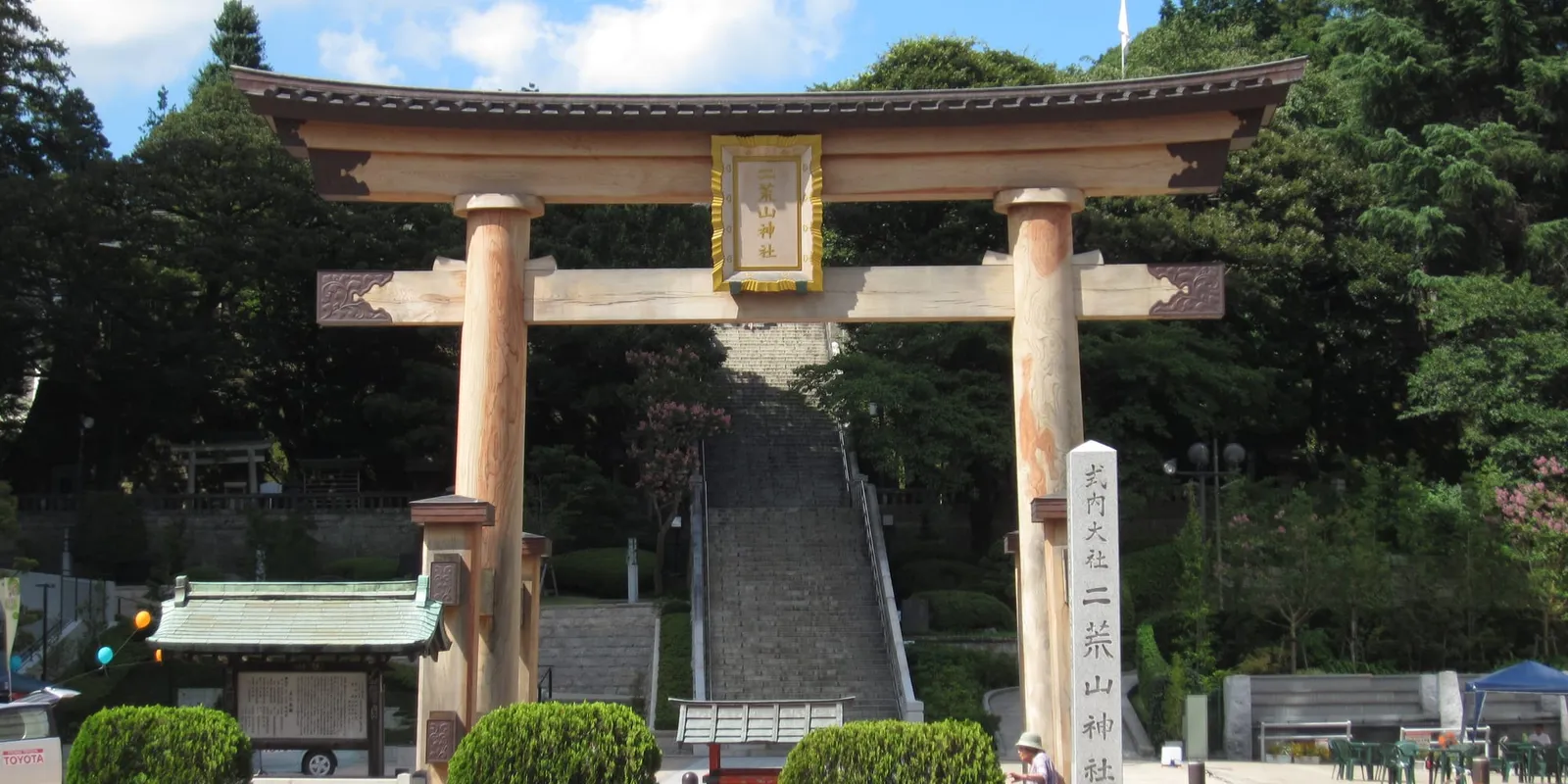
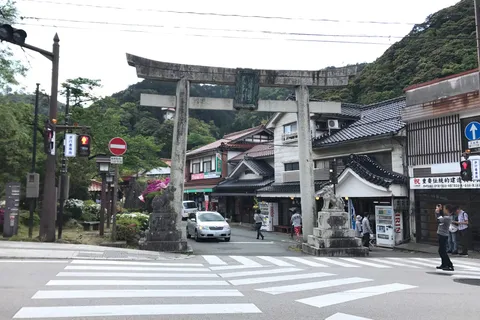
Beyond the great torii gate at the main approach lies a stone staircase of 95 steps. At the top of this climb, on the hilltop, stand the shrine gate, worship hall, and main hall, and the view over the city from this hill — known as Myojin-yama — is one of the highlights of a visit. Alongside the main staircase, a gentler-sloped path called the “Onna-zaka” (women’s slope) and a western approach path are also available, so visitors can choose a route suited to their stamina or companions.
The grounds are also home to twelve sub-shrines. Among them, Shimo-no-miya — said to be the very site of the shrine’s founding — the Nyotai-gu, dedicated to the deity of safe childbirth, Hattatsu Inari Jinja, dedicated to the deities of bountiful harvests and commerce, Sugawara Jinja, dedicated to the deity of learning, and Matsuo Jinja, dedicated to the deity of brewing, each draw their own devoted visitors seeking specific blessings. On the east side of the grounds also stand a Toshogu shrine dedicated to Tokugawa Ieyasu and Suga Jinja, known for its Gion-style summer festival.
Visiting Tips
The shrine grounds themselves (open 6:00–18:00) can be visited at any time within those hours, but the shrine office — for goshuin and amulets — is open only 9:00–16:00. The 95-step staircase at the main approach is a memorable sight but can be tiring to climb, so anyone concerned about the steps should consider the gentler Onna-zaka slope instead. Parking is located behind the grounds rather than facing the main street in front, so if using a car navigation system, searching for “Futaarayama Jinja parking lot” (二荒山神社駐車場) will get you there more reliably than the shrine’s front address. The shrine gets especially crowded during the Kikusui Festival, New Year’s, and the Shichi-Go-San season in November, so an early weekday morning is the best time for a quieter visit.
Annual Festivals
- Spring and Winter Procession Festivals, Otariya (January 15 and December 15): Said to date back to the late Heian period, this ritual sends a mikoshi carrying the deity’s spirit through the city to visit individual households, praying for household safety and good health.
- Annual Festival, Akiyama Festival (October 21): The shrine’s most solemn annual rite, said to have begun in 940 as an imperial ceremony of thanks for the suppression of the rebellion of Taira no Masakado.
- Kikusui Festival (last Saturday and Sunday of October): Begun in 1673 in gratitude for the shrine being spared from a fire, this celebratory event developed as an accompanying festival to the Akiyama Festival, featuring a Horen Togyo palanquin procession carrying the enshrined deity through the city and a traditional yabusame archery ritual.
- Shichi-Go-San (around November 15): A rite celebrating the growth of children — boys at ages three and five, girls at ages three and seven — giving thanks and praying for their continued healthy growth.
- Tenno Festival (July 15–20): The summer festival of the sub-shrine Suga Jinja, rooted in the Gion Festival of Kyoto’s Yasaka Shrine, praying for protection from epidemics.
- Great Purification Rites (June 30 and December 31): Rituals to purify the sins and impurities of the past half-year or full year; the June rite includes passing through a great ring of woven grass known as the chinowa.
Nearby Food & Sightseeing
- Kirasse Main Store: About a 4-minute walk from the shrine, this dumpling hall gathers many of Utsunomiya’s most celebrated gyoza restaurants under one roof — a popular stop for sampling the city’s famous gyoza.
- Matsugamine Catholic Church: About a 15-minute walk from the shrine via the Orion-dori shopping arcade, this early-Showa-era church is notable for its twin towers built from Oya stone, a local volcanic rock.
- Orion-dori: A covered shopping arcade just steps from the shrine, lined with restaurants and shops — a convenient hub for exploring central Utsunomiya on foot.
Frequently Asked Questions
- Q. Is Utsunomiya Futaarayama Jinja the same shrine as Nikko Futarasan Jinja?
- A. No — they are entirely separate shrines. Even the reading of the name differs: this shrine is Futaarayama-jinja, while the shrine in Nikko is Futarasan-jinja. The enshrined deities differ too — Toyokiirihiko no Mikoto here, versus Onamuchi no Mikoto and two other deities at Nikko Futarasan Jinja — and so do the founding legends: this shrine traces its origin to the provincial governor Narawake no Kimi enshrining his ancestor Toyokiirihiko, while Nikko Futarasan Jinja began with the monk Shodo Shonin's worship of Mt. Nantai. Both shrines claim the title of ichinomiya (highest-ranked shrine) of former Shimotsuke Province, and scholars still have not settled which one the Heian-era Engishiki shrine registry's entry for 'Futaarayama Jinja, Kawachi District, Shimotsuke Province' actually refers to. A Kamakura-period anecdote collection, the Zoku Kojidan, even describes the Utsunomiya shrine as a 'branch shrine' of the Nikko deity — but this is now considered a historical misunderstanding, and the two are treated as independent shrines that happen to share a very similar name.
- Q. Can I get a goshuin here? What are the hours and fee?
- A. Yes, a goshuin is hand-written to order at the shrine office (no pre-printed versions are offered). It's available roughly 9:00–16:00 for ¥500. Illustrated goshuin featuring the companion deities Omononushi (Daikokuten) and Kotoshironushi (Ebisu), sold as a set of two, are also available.
- Q. Is there parking at the shrine?
- A. Yes, visitor parking is located behind the shrine grounds, open 8:00–21:00 with space for up to 300 vehicles. It costs ¥300 per 60 minutes, up to a maximum of ¥1,500 for 12 hours, and is free for up to 2 hours for anyone receiving a prayer service (kito). A wheelchair-accessible parking area is also available on the east side of the grounds.
- Q. What is the Kikusui Festival?
- A. Said to have begun in 1673 in gratitude for the shrine being spared from a fire, this festival of celebration developed as an accompanying event to the shrine's main annual festival (the Akiyama Festival, held October 21) and took the name Kikusui ("chrysanthemum water") from its association with the Chrysanthemum Festival on the old lunar calendar. It's now held on the last Saturday and Sunday of October, and its highlights are the Horen Togyo — a palanquin procession carrying the spirit of the enshrined deity Toyokiirihiko through the city — and a traditional yabusame (mounted archery) ritual.
- Q. How do I get to Utsunomiya Futaarayama Jinja?
- A. It's about a 5-minute bus ride from the west exit of JR Utsunomiya Station (or about a 20-minute walk), and about a 15-minute walk from Tobu Utsunomiya Station. By car, it's about 25 minutes from the Kanuma Interchange or 20 minutes from the Utsunomiya Interchange on the Tohoku Expressway.
Related Shrines
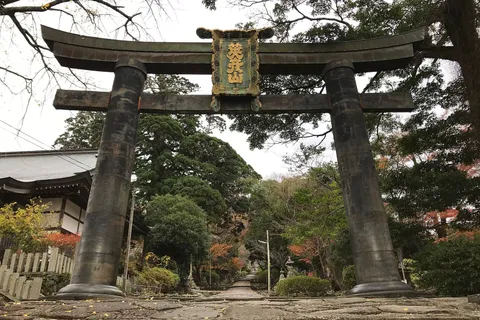
Fukuoka, Soeda, Tagawa District
Hikosan Jingu
Hikosan Jingu
- Good Fortune
- Protection from Misfortune
- Household Safety
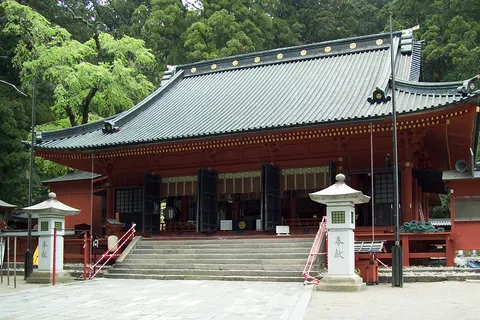
Tochigi, Nikko
Nikko Futarasan Jinja
Nikkō Futarasan-jinja
- Good Relationships
- Good Fortune
- Household Safety
Shimane, Tsuwano
Taikodani Inari Jinja
Taikodani Inari-jinja
- Business Prosperity
- Bountiful Harvest
- Good Fortune