History
Mekari Jinja stands on a bluff overlooking Hayatomo-no-Seto, the point where the Kanmon Strait — the narrow channel separating Honshu from Kyushu — pinches to its narrowest width. According to shrine tradition, it was founded in 200 CE (the 9th year of Emperor Chuai’s reign) by Empress Jingu, who established it in gratitude to the deities of the tides upon her return from the legendary conquest of the Korean peninsula. That places its origins in the late Yayoi period, roughly 1,800 years ago. Through the Edo period the shrine was also known as Hayato-sha (“the shrine of the strait”), a name reflecting its guardianship of the passage below.
The shrine enshrines five deities: Tsukisakaki Itsunomitama Amasakaru Mukatsuhime no Mikoto — better known by her alternate name, Seoritsu-hime, a goddess who governs the ebb and flow of the tides — together with Hikohohodemi no Mikoto (the sea-god Yamasachihiko), his consort Toyotama-hime no Mikoto, their son Ugayafukiaezu no Mikoto, and Azumi Isora no Kami, a deity long venerated by the seafaring Azumi clan. Fittingly for a shrine dedicated to deities of the sea, its halls face directly out over the strait. Historical records trace a long line of reconstructions and renovations sponsored by the regional lords who held sway over this strategic strait crossing — from Ashikaga Takauji’s rebuilding of the shrine in 1336, through grants of shrine lands and further reconstructions by the Ouchi clan in the 14th and 15th centuries, to further rebuilding under the Ouchi and local lord Nio Hitachinosuke in the 16th century.
In recent years the shrine has drawn renewed attention as a “shrine of guidance.” Under head priest Takase Kazunobu, who joined the shrine in 2009 and became its 32nd-generation negi in 2010, the shrine’s goshuin, amulets, and grounds were refreshed, and its annual revenue grew from roughly ¥5 million to about ¥180 million — a turnaround profiled in a 2026 Toyo Keizai Online feature. Even as it embraces this modern chapter, the shrine continues to carry forward its identity as a historic guardian of the strait.
The Mekari Shinji Ritual
Mekari Jinja is known nationwide for the Mekari Shinji, a ritual held in the dead of night between the lunar New Year’s Eve and the early hours of New Year’s Day. It is said to originate from an episode in which Empress Jingu herself harvested wakame seaweed from the strait to offer in thanks upon her triumphant return from the legendary conquest of the Korean peninsula — a tradition said to have been carried on for roughly 1,800 years.
After a ceremonial Yokoshiro Yudate Kagura dance is performed, three priests dressed in hunting robes (kariginu), black lacquered caps (eboshi), white tabi socks, and straw sandals, led by a torch roughly three meters tall, wade into the frigid midwinter strait at low tide. By torchlight alone, they hand-harvest the wakame clinging to the rocks of the strait, piece by piece, and carry it back to offer before the kami. The sight of priests working by torchlight in the dark winter sea is striking, and on both shores of the Kanmon Strait it is taken as a sign that spring is drawing near. The ritual was designated an Intangible Folk Cultural Property of Fukuoka Prefecture on April 3, 1958, and its exact date each year still follows the old lunar calendar.
A Shrine Overlooking the Strait
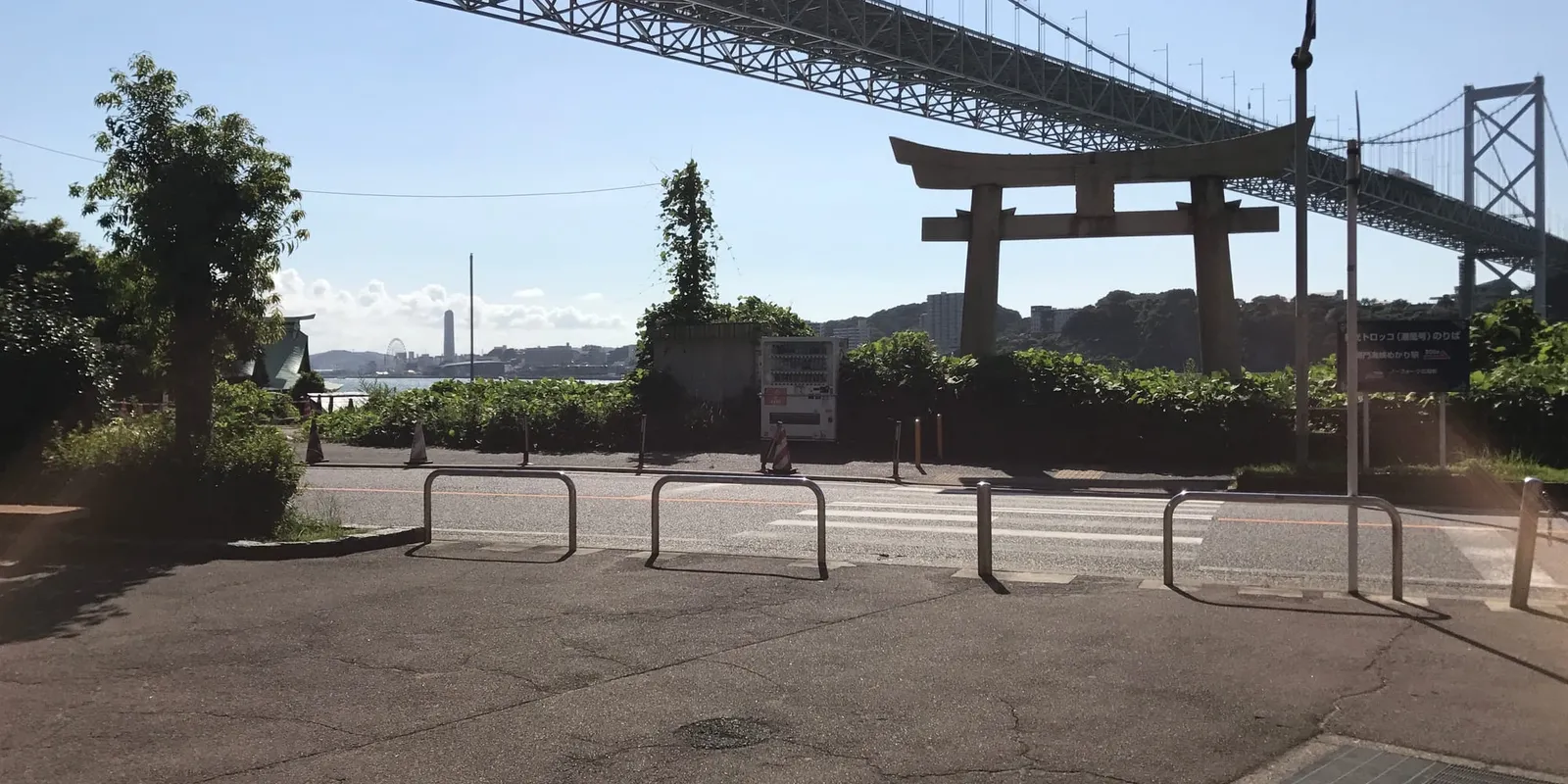
From the shrine grounds, visitors look straight down onto the Kanmon Strait and up at the Kanmon Bridge spanning it overhead. Hayatomo-no-Seto, the point where Honshu draws closest, is known for its fast, treacherous currents, and it is this dramatic setting — at the northernmost point of Kyushu, with the opposite shore in plain view — that makes Mekari Jinja so distinctive. The view through the shrine’s vermilion torii gate out across the strait to the bridge is a popular photo spot, and because the Moji-side entrance to the Kanmon Pedestrian Tunnel is close by, many visitors combine a stop here with a visit to the nearby Mojiko Retro district.
Blessings
As a shrine dedicated to deities who govern the tides, Mekari Jinja has long been venerated by fishing communities for maritime safety and bountiful catches. In recent years it has also become known as a “shrine of guidance,” drawing visitors facing a turning point or a difficult decision in life. Because goddesses including Toyotama-hime no Mikoto are also enshrined here, the shrine is associated with good relationships as well, and the New Year’s timing of the Mekari Shinji ritual draws visitors seeking good fortune for the year ahead.
Visiting Tips
The shrine is open for visits from 9:30 to 17:00. On-site parking (about 50 spaces) makes a visit by car easy, but the shrine is also reachable by bus or sightseeing train from the Mojiko Retro district, making it easy to combine with sightseeing around Mojiko Station. The view of the strait and bridge from the grounds is especially striking at dusk, and on a clear day you can see all the way across to Shimonoseki on the opposite shore. If you plan to attend the Mekari Shinji ritual itself, remember that it takes place in the middle of a winter night, so dress warmly.
Nearby Food & Sightseeing
The Mojiko Retro district is lined with Taisho- and early Showa-era Western-style buildings and is known for its local specialty, yaki curry (baked curry rice), served at numerous restaurants in the area. The Kanmon Strait is also crossed by a pedestrian tunnel beneath the seabed, letting visitors walk — or cycle — between Fukuoka and Yamaguchi prefectures on foot.
- Mekari Park — Adjacent to the shrine, this park offers an observation plaza with close-up views of the Kanmon Bridge, and the Mekari Daini observation deck is known for its night views.
- Mojiko Retro District — A historic waterfront area with Taisho- and Showa-era Western buildings, including the former Moji Customs House and former Mojiko Mitsui Club, lined with restaurants serving the local specialty, yaki curry.
- Kanmon Pedestrian Tunnel — A rare tunnel beneath the Kanmon Strait that can be crossed on foot or by bicycle, with entrances on both the Moji and Shimonoseki sides, letting you walk across the prefectural border underground.
Frequently Asked Questions
- Q. What are the visiting hours?
- A. 9:30–17:00.
- Q. Can I get a goshuin here?
- A. Yes, during visiting hours (9:30–17:00), for a fee of ¥500.
- Q. How do I get to Mekari Jinja?
- A. It's about a 25-minute walk from JR Mojiko Station, or about 13 minutes by Nishitetsu Bus (route 4 or 74) from Mojiko Ekimae to the Mekari Jinja-mae stop, which drops you right at the shrine. The Mojiko Retro sightseeing train also stops at Kanmonkaikyo Mekari Station, about a 5-minute walk away.
- Q. Is there parking?
- A. Yes, the shrine has an on-site parking area with about 50 spaces for visitors. Large tour buses use the nearby Mekari Pool parking area instead.
- Q. What is the Mekari Shinji ritual?
- A. In the dead of night between the lunar New Year's Eve and the morning of New Year's Day, Shinto priests descend to the narrowest point of the Kanmon Strait, Hayatomo-no-Seto, at low tide, and by torchlight hand-harvest sacred wakame seaweed from the rocks to offer to the kami. The ritual is said to originate from an episode in which Empress Jingu herself harvested the strait's wakame to give thanks upon returning from her legendary conquest of the Korean peninsula, and the tradition is said to span roughly 1,800 years. It was designated an Intangible Folk Cultural Property of Fukuoka Prefecture on April 3, 1958.