History
Ushiodake Jinja is an old shrine nestled in the hills of Kitago, Nichinan City, Miyazaki Prefecture. Shrine tradition dates its founding to the reign of the legendary Emperor Jimmu, though the exact year is unknown. Its enshrined deity, Honosuseri no Mikoto, is known in Japan’s founding myths as Umisachihiko (“Luck of the Sea”), the elder brother in the “Umisachi-Yamasachi” story.
According to the Kojiki and Nihon Shoki, Umisachihiko traded fishing tools with his younger brother Yamasachihiko (Hikohohodemi no Mikoto) — a fishhook for a bow and arrows — but Yamasachihiko lost the borrowed hook at sea. When Yamasachihiko eventually recovered the hook and returned, a conflict broke out between the brothers; Umisachihiko was ultimately defeated by his brother’s power over the tides and submitted to him, pledging his service. Shrine tradition here adds a local chapter to that story: after his defeat, Umisachihiko is said to have boarded a sturdy vessel and drifted ashore on the rising tide, settling in this area — giving rise to the place name “Ushiodake” (“tide peak”). Yamasachihiko (Hikohohodemi no Mikoto) and Hoakari no Mikoto are also enshrined on the grounds, but Ushiodake Jinja is considered the only shrine in Japan that enshrines Umisachihiko as the principal deity of its main hall. He has long been venerated here as the ancestral deity of the Hayato people and a guardian of maritime safety and bountiful catches. Where nearby Udo Jingu, also in Nichinan, enshrines Hikonagisatakeugayafukiaezu no Mikoto — the son of the victorious younger brother Yamasachihiko — Ushiodake Jinja tells the other half of the story, giving the defeated elder brother himself the leading role.
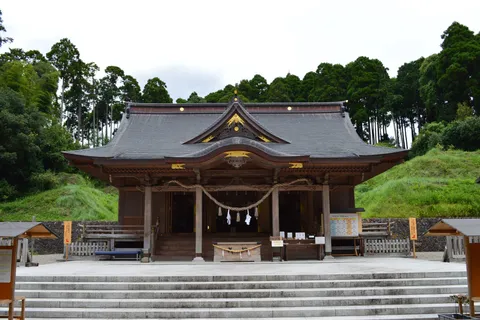
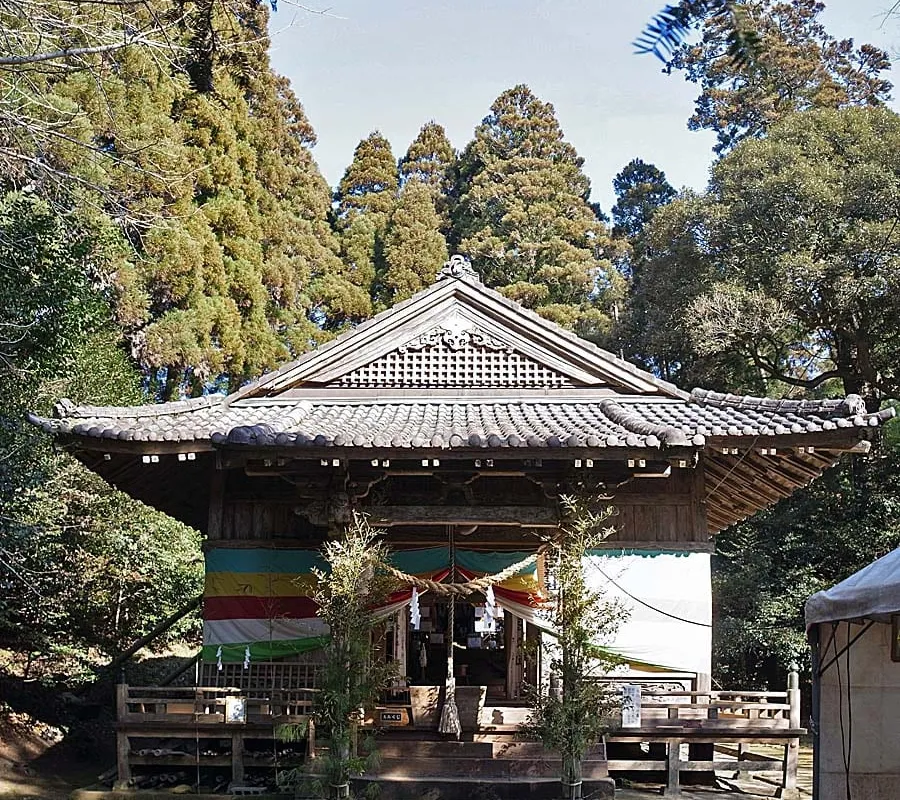
The current main hall was built around 1832 through the patronage of the Ito clan, lords of the Obi domain, and still bears the family’s crests. It is a flowing-roof (nagare-zukuri) structure decorated with vividly painted carvings and elaborate Chinese lion (karashishi) reliefs — an unusually ornate building for such a small, rural shrine. The worship hall is said to have been rebuilt in 1899. In 1872, six neighboring shrines were merged into it and its name was changed from “Ushiodake Daigongen” to “Ushiodake Jinja.”
Local Legends
Traditions connected to Umisachihiko extend beyond the shrine grounds themselves. About 1.5 km west of the shrine stands Otsuka Kofun, a burial mound said to be Umisachihiko’s grave; after the site was disturbed in the early Meiji era, local residents built a small shrine there and it has since been treated as sacred, off-limits ground. Kashikodokoro, the spot where Umisachihiko is said to have come ashore on the tide, is marked by sacred trees that are still left untouched today, in the belief that cutting them invites misfortune. In the forest north of the shrine, a site known as Kyozuka (or Ushio-Kōza) is said to have been where taro offerings were made annually to the myriad gods until the early Taisho era.
The area also preserves customs tied directly to the myth: because the brothers’ dispute in the legend centers on a borrowed and lost fishhook, local custom holds that lending or borrowing sewing needles is taboo. Another local tradition has parents write the character for “dog” (犬) on an infant’s forehead in red ink during the child’s first shrine visit, said to stem from the Hayato people — descendants of Umisachihiko who served the imperial court and whose barking-like ceremonial cries were believed to ward off evil spirits.
The main hall itself, donated by the Ito clan of Obi, is worth a close look for its vividly painted decoration and carved karashishi lions — a surprising level of ornamentation for such a remote shrine. To the left of the grounds stands a smaller shrine dedicated to the spirits of the parish’s ancestors.
Visiting Tips
The approach involves a flight of stone steps up to the main hall, but the grounds themselves are free to enter at any time. Goshuin can be received at the shrine office just past the first torii gate, on the left — but since the shrine has no resident priest, it’s worth calling ahead (+81-987-55-3252) to check whether staff will be present, especially if traveling a long way to visit.
Because the shrine sits in the hills, somewhat removed from central Nichinan and the Udo Jingu area, visiting by rental car is the most realistic option. The roads in are mountain roads, so it’s worth allowing extra travel time.
Annual Festivals
- Spring Festival (February 11): The “Ushiodake Kagura” sacred dance is performed, with fourteen sacred wands bearing the names of deities set up around the grounds. Preceded by the “Fukutane-oroshi” seed-blessing rite, offerings of tuna, bonito, and wild boar meat are made before an all-night program of dances including the “fishing dance,” praying for a good harvest, a bountiful catch, and successful hunts.
- Autumn Festival (second Sunday of November): Features the “Ushiodake Lion Dance,” designated an intangible folk cultural property of Nichinan City, along with the “Miko Dance,” performed by four local girls holding sakaki branches and fans. The Miko Dance is said to depict Emperor Jimmu’s farewell to the area, and is still accompanied by an ancient poem recorded in the Shoku Nihongi.
Nearby Food & Sightseeing
- Michi-no-Eki Kitago: A roadside station in Kitago that opened in October 2023, serving dishes made with locally landed bonito and wood-fired pizza, plus one of Kyushu’s largest inclusive playgrounds — a convenient stop for families visiting the shrine.
- Inoyae Gorge: A scenic gorge in the hills of Kitago, known for its clear stream and untouched forest — a hidden spot for cooling off in summer or viewing autumn foliage.
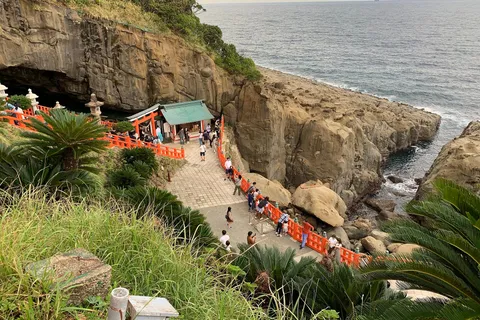
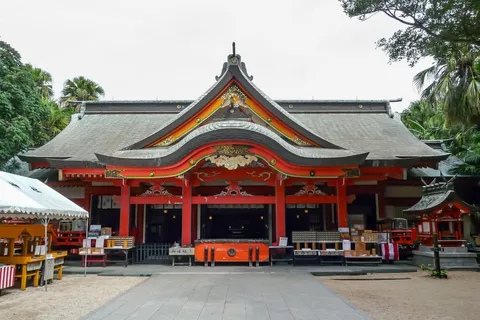
- Udo Jingu: A short drive toward the Nichinan coast, this well-known shrine enshrines the son of Yamasachihiko, the victorious younger brother. Visitors interested in the full “Umisachi-Yamasachi” myth cycle often combine a visit to both shrines.
Frequently Asked Questions
- Q. What kind of shrine is Ushiodake Jinja?
- A. It is a rare shrine that enshrines Honosuseri no Mikoto (Umisachihiko), the elder brother who loses to his younger brother Yamasachihiko in the "Umisachi-Yamasachi" myth, as the principal deity of its main hall. Local tradition holds that after his defeat, Umisachihiko drifted ashore here on the tide and settled in the area.
- Q. Can I receive a goshuin here?
- A. Yes, at the shrine office, from 8:00 AM to 5:00 PM, for ¥500. The shrine has no resident priest, so the office is sometimes unattended — visitors traveling a long way are advised to call ahead (+81-987-55-3252) to check.
- Q. How do I get there?
- A. It's about 8 minutes by car or taxi from JR Kitago Station on the Nichinan Line, or about 18 km from Tano IC on the Miyazaki Expressway. A local bus stops nearby at Shimoshukuno, but service is infrequent, so a car is the most practical way to visit.
- Q. Is there parking?
- A. Yes, free parking for about 20 cars is available on the grounds.
- Q. When are the shrine's festivals held?
- A. The Spring Festival on February 11 features the "Ushiodake Kagura" sacred dance, including a fishing-themed dance. The Autumn Festival, on the second Sunday of November, features the "Ushiodake Lion Dance" and "Miko Dance," both designated intangible folk cultural properties of Nichinan City.