Featured Guides / 9 Unmanned Shrines Insiders Can't Stop Talking About
9 Unmanned Shrines Insiders Can't Stop Talking About
We introduce nine mysterious shrines that have no resident priest — standing deep in the mountains or on remote islands, far from any town — yet continue to draw visitors who can't stay away.
- 1
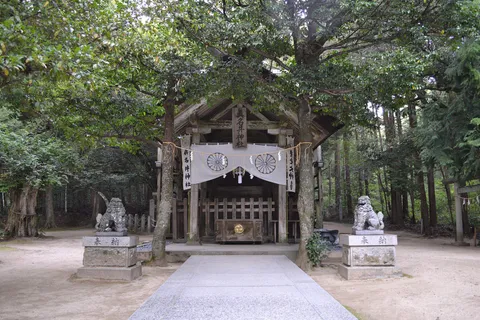
Tucked away in the mountains of Kamo, Tsuyama City, Okayama Prefecture, stands the Okunomiya of Samuhara Jinja — a small shrine easy to miss, and yet the true wellspring of the "Samuhara" sacred characters that sparked a nationwide boom as the ultimate charm against bullets and misfortune. This remote Okunomiya, not the famous shrine in Osaka, is where that faith actually began. There is no shrine office, no counter for amulets, and no resident priest of any kind. Only after climbing roughly 300 stone steps does the shrine building finally come into view, the sacred "Samuhara" characters carved here and there along the way, and the approach is difficult enough — even car navigation has been known to send visitors astray — that online communities describe it as a power spot that "only those called by the gods can reach." Anyone hoping for a goshuin or an amulet needs to contact the main shrine in Osaka instead.
- 2
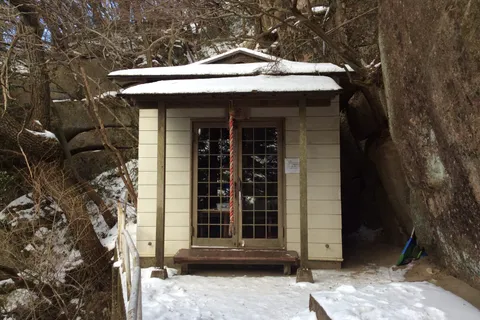
Mana-i Jinja, the okunomiya of Moto-Ise Kono Jinja, stands quietly at the top of a mountain path that continues some ten minutes further up from Kono Jinja's rear approach. Behind the main hall lies an iwakura — a sacred rock formation that Jomon- and Yayoi-period people are believed to have worshipped as a deity in its own right, long before any shrine building stood here — and this sacred ground remains strictly forbidden to both entry and photography. Mana-i Jinja's own shrine office opens only a handful of days each month; on every other day, it stands wrapped in silence, quietly guarding a water deity whose worship reaches back to ancient times.
- 3
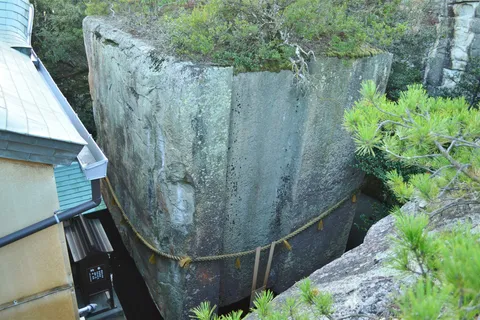
The go-shintai of Oushiko Jinja in Takasago, Hyogo Prefecture, is the Ishi-no-Hoden — a colossal stone monument counted among Japan's "Three Mysteries." Measuring 6.4 meters wide, 5.7 meters tall, and an estimated 500 tons in weight, its sheer, otherworldly scale is matched only by its strange appearance of floating on the water pooled around its base, which has earned it the nickname "the floating stone." Who carved it, when, and for what purpose has been debated since ancient times, and while modern archaeology's leading theory holds that it's an unfinished stone burial chamber, no definitive answer has ever been reached. The shrine office isn't always staffed, and when the priest is away, only a quietly waiting pre-written goshuin awaits visitors in their place.
- 4
Deep in a ravine on Mt. Rokko above Kobe, reached only by cable car and bus followed by more than ten minutes on a steep mountain trail, stands Rokko Hime Jinja. Its shrine hall appears cradled by three great sacred boulders — an iwakura — named Kumo-ga-iwa, Shingyo-iwa, and Gyoga-iwa. No priest is stationed here, and amulets and goshuin are entirely self-service. In recent years it has increasingly been introduced as a "power spot," yet the hush and quiet tension of mountain worship itself remain as vivid as ever.
- 5
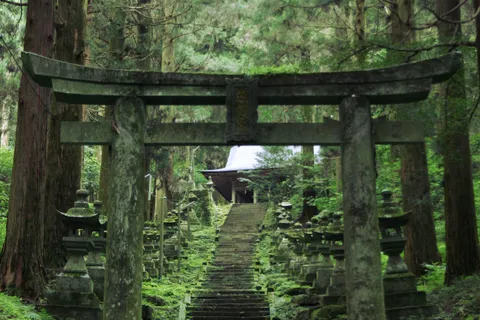
What made Kamishikimi Kumanoza Jinja in Takamori, Kumamoto Prefecture, suddenly famous is the stone stairway of roughly 250 steps that begins just past its torii. Lined with around 100 moss-covered stone lanterns beneath a canopy of cedar trees, the approach became a social-media sensation as an "entrance to another world," and even inspired a scene in an animated feature film. Not even the small shrine hall waiting at the top of the stairs has a priest in attendance — it welcomes visitors in silence, unmanned around the clock. Climb roughly another ten minutes up the mountain path behind the hall, and you'll reach Ugetoiwa, a massive boulder pierced clean through — legend holds that a servant fleeing the enshrined deity's wrath kicked straight through the solid rock to escape, and the boulder is still revered today as a symbol that no difficulty is too great to overcome.
- 6
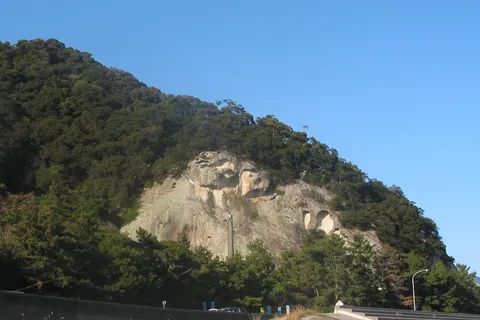
Hananoiwaya Jinja, in Kumano City, Mie Prefecture, has no main hall at all. Its go-shintai is a sheer cliff face roughly 45 meters high, already recorded in the Nihon Shoki as the burial place of Izanami no Mikoto. With no shrine building to block the view, nothing stands between visitor and rock — a space for encountering primeval nature worship unlike anywhere else in Japan. The grounds can be visited 24 hours a day, and although no priest is stationed on-site, goshuin are handled at the sanroden hall next door, which also serves as part of the adjoining roadside station.
- 7
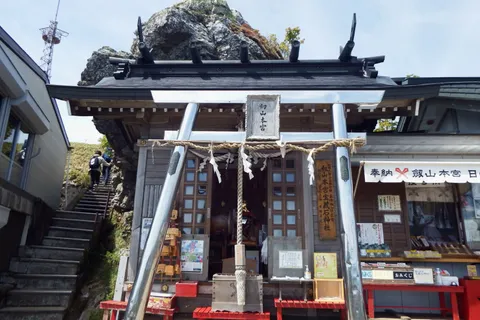
At 1,955 meters, near the summit of Mt. Tsurugi, one of Shikoku's great peaks, stands Tsurugisan Hongu Hozoishi Jinja. Even after riding the cable lift to its final stop, visitors still face some 40 minutes of walking along a ridge trail to reach it — and clinging to this remote shrine is the famous legend that the Ark of the Covenant of ancient Israel lies hidden somewhere in the mountain. This theory traces back to the early-Showa-era "Japanese-Jewish common ancestry" argument and has never been substantiated as historical fact. The shrine office is staffed mainly on weekends from late April through early November; outside that season, and especially once the winter snows arrive, no one at all remains on the empty summit — only the sacred boulder Hozo-ishi, standing quietly alone.
- 8
At Okama Jinja in Shiogama, Miyagi Prefecture, four iron cauldrons rest within the grounds, and even Edo-period records preserve the belief that when the color of their water changes, something extraordinary is about to happen. In more recent memory, some have spoken of the water appearing to change color on the very day of the Great East Japan Earthquake in 2011 — but this has never been scientifically verified, and should be received as handed-down legend rather than established fact. No calligrapher is stationed on the grounds, so every goshuin here is pre-written; anyone wanting one inked to order needs to travel to the main shrine, Shiogama Jinja.
- 9
Kumano Idehayao Jinja stands at the summit of Mt. Minakami, in Matsushiro, Nagano City. Its strikingly regular, cone-like shape — so different from the mountains around it — gave rise, in the 1930s, to the claim that it was "an artificial pyramid built in ancient Japan," a legend still told today. Geological surveys, however, have confirmed it to be a natural lava dome formed roughly 300,000 to 350,000 years ago, with no evidence whatsoever of human construction. What is real, on the other hand, is the "Matsushiro earthquake swarm" — a genuine geological phenomenon centered directly beneath this mountain, in which more than 711,000 tremors were recorded over five and a half years beginning in 1965. No priest is stationed at the shrine hall on the summit, and every goshuin here is issued pre-written.
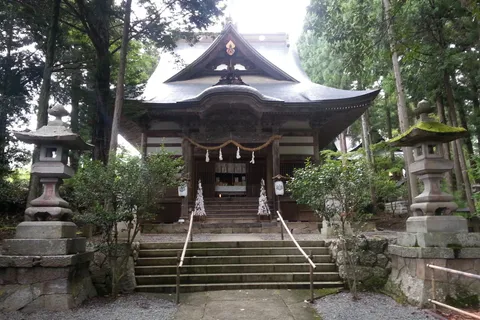
Visiting Japan’s “Unmanned” Shrines
Shrines with no resident priest — standing deep in the mountains, on remote islands, or in other places far from any town — can still be found all across Japan today. Many trace their roots back to forms of nature worship older than shrine architecture itself, such as sacred-rock (iwakura) veneration or the mountain asceticism of Shugendo, and what defines them isn’t convenience but the journey required to reach them — a journey that becomes part of the visit itself.
If you’re hoping for a goshuin or an amulet, it’s common to find only pre-written copies available, or to need to travel to a main shrine or nearby tourist information center instead. Checking ahead of time will save you confusion once you’re there.
Things to Keep in Mind When You Visit
- Research your route in advance: Many of these shrines require walking mountain trails or unpaved roads, and in some cases car navigation can direct you to the wrong place entirely. Check your walking route and travel time beforehand.
- Mind your footwear and gear: Stone stairways, steep mountain paths, and unpaved approaches are common, so wear shoes built for walking. Avoid visiting after dark, and aim to arrive while it’s still bright out.
- Enjoy the legends as legends: Several of these shrines carry urban legends tied to ancient artifacts, but most are unproven theories that spread in relatively modern times. Enjoy them alongside — not in place of — each shrine’s own authentic history.
You can find full details on each shrine’s history, access, and goshuin information on its individual page.