Featured Guides / 10 Mysterious Legends Passed Down at Japan's Shrines
10 Mysterious Legends Passed Down at Japan's Shrines
From the month when Japan's deities gather at Izumo to the legend of Abe no Seimei's shikigami spirits, we introduce ten shrines carrying strange, faintly chilling legends that still linger in the air today.
- 1
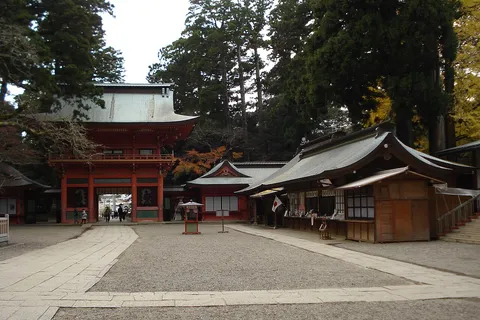
Deep within the sacred grounds of Kashima Jingu in Ibaraki Prefecture lies a small stone that barely breaks the surface of the earth. Known as the "Kaname-ishi" (keystone), it is said to press down from above on the head of a colossal catfish that thrashes beneath the ground, causing earthquakes whenever it stirs. During the Edo period, Tokugawa Mitsukuni — the daimyo of Mito domain, popularly remembered as "Mito Komon" — set out to test the legend for himself, ordering his retainers to dig around the stone for seven days and seven nights. But no matter how deep they dug, the bottom of the stone never came into view, and in the end they were unable to reach it. What shows above ground is only the smallest fraction of the whole — and to this day, no one knows its true form, or how deep into the earth it truly reaches.
- 2
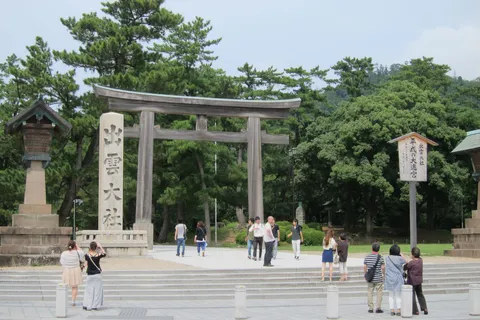
Every year in the tenth month of the old lunar calendar, it is said that the deities of Japan vanish all at once from their own shrines and travel to the land of Izumo. There, they gather to discuss en — the bonds that tie people together, not only in marriage but in every kind of connection between person and person, and between people and the places they belong. During this one period, Izumo alone calls the month "Kamiarizuki," the month the gods are present, while everywhere else in Japan it remains "Kannazuki," the month of their absence. Along Inasa-no-Hama Beach, a creature known as Ryuja-sama — a sea snake believed to guide the deities on their journey — occasionally washes ashore from the far southern seas; when one is found, it is respectfully enshrined and offered at the Grand Shrine. In one particular year, residents say, just such a snake was carried onto the beach as if announcing the gods' arrival in person — a quiet story still told among the people of Izumo today.
- 3
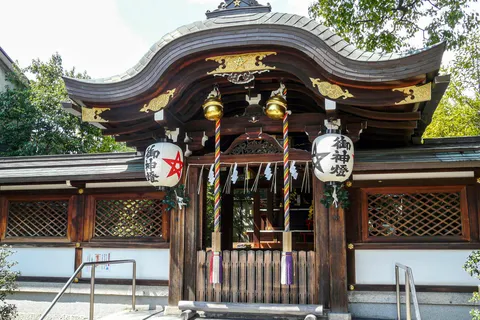
During the Heian period, Abe no Seimei rose to fame as the greatest onmyoji in the capital, said to command a host of invisible spirit-servants known as shikigami, bending them entirely to his will. Some tales hold that these shikigami opened and closed the doors of his household in his place; others say they moved invisibly through his home, tending to his daily needs. The presence of these unseen beings was said to be so unsettling that Seimei's own wife could not bear to look upon them, and one account holds that Seimei kept his shikigami hidden beneath Ichijo Modoribashi, the bridge just south of where his shrine now stands. Within the grounds of Seimei Jinja lies the Seimei Well, said to have been summoned forth by Seimei's own spiritual power; its spout is turned each year to face that year's auspicious direction, and it is said that when plague once spread through the capital, Seimei used this very water to save the afflicted.
- 4
Kifune Jinja is adored by young women nationwide as a shrine of enmusubi — yet hidden behind that gentle reputation is a far darker legacy: this is said to be the birthplace of Japan's most infamous curse, the "Ushi no Koku Mairi," the Hour of the Ox Ritual. The Noh play Kanawa tells of a woman known as Hashihime of Uji, betrayed by her husband. Consumed by jealousy and grief, she came before the deity of Kifune and prayed, in the depths of night — around two in the morning, the "Hour of the Ox" — to be transformed into a living demon. For seven nights she kept vigil in prayer, then bound an iron trivet upon her head, painted her face crimson, dressed in robes of red, and submerged herself in the waters of the Uji River for twenty-one days — until at last she became a demoness and took her revenge on her husband and the woman who replaced her. It is this legend of Hashihime that is said to have given rise to the ritual still spoken of in hushed tones today: driving nails through a straw effigy in the dead of night. The memory of that terror lingers quietly in the valley of Kifune even now.
- 5
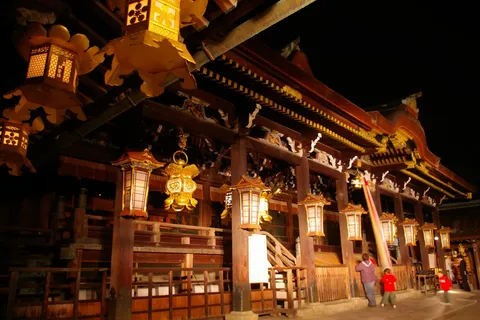
Kitano Tenmangu is beloved nationwide today as the "God of Learning," a patron of students facing exams — but its very founding is rooted in one of the most feared cases of vengeful-spirit wrath in the capital's history. Sugawara no Michizane rose to the exalted rank of Minister of the Right, only to be brought down by the slander of his political rival, Fujiwara no Tokihira, and exiled to Dazaifu, where he died in bitter despair. After his death, calamity after calamity struck the capital: members of the Tokihira clan died one after another of illness, the crown prince himself perished young, and finally, in the year 930, lightning struck the Seiryoden imperial hall, killing several court nobles in a single catastrophic instant. Terrified, the people of Kyoto came to believe that Michizane's vengeful spirit had transformed into the god of thunder itself, and only by pacifying his soul and enshrining him with the utmost reverence did the capital finally find peace again. The shrine that today draws countless visitors praying for exam success was born, at its root, from the desperate plea of a terrified capital: please, let the curse end here.
- 6
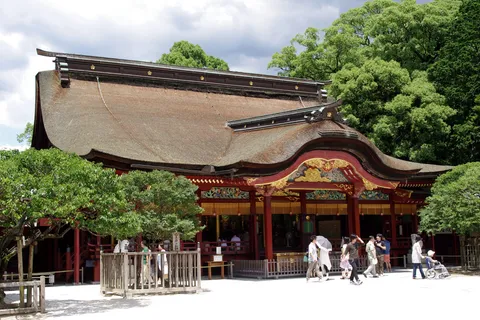
As Michizane was driven from Kyoto, he bid farewell to the plum tree in his garden that he had cherished above all else, composing a poem of longing: "When the east wind blows, send me your fragrance, plum blossoms — do not forget the spring, though your master is gone." As if answering that plea, the tree is said to have flown through the night sky in a single night, following its master all the way to distant Dazaifu, where it took root once more — the legend of the "Tobiume," the flying plum. The main hall of Dazaifu Tenmangu stands directly above the spot where Michizane himself is said to be buried, and the sacred Tobiume tree still blooms there every year within the shrine grounds. It is known to flower earlier than every other plum tree on the grounds — as if, even now, it still longs for its master far away in the old capital.
- 7
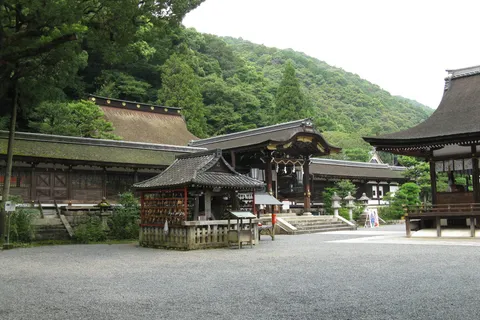
When Heian-kyo was laid out as the new capital, its very design is said to have drawn deeply on the principles of onmyodo. The northeast direction — the "kimon," or demon gate, through which evil spirits were believed to enter — was guarded by Enryaku-ji on Mt. Hiei, while directly opposite, to the southwest, the "ura-kimon," or rear demon gate, was sealed by Matsuo Taisha. According to this theory, shrines and temples were deliberately placed at the capital's most vulnerable compass points, weaving an unseen barrier of protection across the entire city — a vast, invisible ward built directly into the urban planning of a capital over a thousand years old. Matsuo Taisha's long history as the object of deep reverence from the imperial court and nobility as the "god of sake brewing" may reflect not merely its role as a patron of an industry, but a far weightier duty: standing guard, unseen, over the capital itself.
- 8
In the depths of winter, when Lake Suwa freezes over completely, a single straight crack sometimes tears across the ice, buckling upward into a jagged ridge like a miniature mountain range. This is the "Omiwatari" — literally, "the God's Crossing." Since ancient times, the people of Suwa have believed this to be the path left behind when Takeminakata-no-kami, the god enshrined at the Kamisha (Upper Shrine), crosses the lake night after night to visit the goddess enshrined at the Shimosha (Lower Shrine). At Suwa Taisha, a rite called the Omiwatari Haikan Shinji is still held each year, in which priests determine whether the Omiwatari has appeared and, based on the direction of its cracks, divine the fortunes of the coming year and the outlook for the harvest. In recent years, however, as global warming has made years when Lake Suwa fails to freeze over completely more common, quiet concern has grown that this nightly meeting between the gods may itself be vanishing.
- 9
Since ancient times, the land of Kumano has been feared and revered as the place lying closest to the realm of the dead — Yomi, the land of the departed. When Emperor Jinmu lost his way deep in the mountains of Kumano during his legendary eastward journey, tradition holds that a three-legged sacred bird was sent down from heaven to guide him safely through the treacherous terrain: Yatagarasu. Kumano Hongu Taisha has long enshrined Yatagarasu as a divine messenger, and its distinctive form is now familiar nationwide as the symbol of the Japan Football Association. That a guide meant to lead the living safely home should emerge from a land said to border the realm of the dead — this legend, where life and death intertwine, still quietly sustains the very foundations of Kumano's ancient faith.
- 10
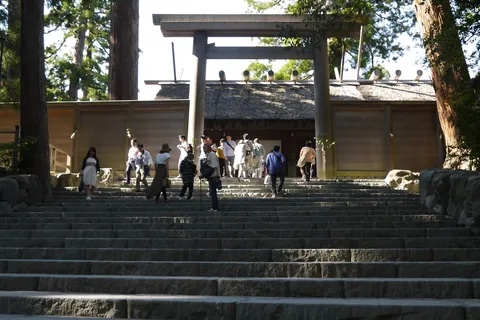
Once every twenty years, every one of Ise Jingu's structures is rebuilt entirely anew in the great rite of Shikinen Sengu — a tradition carried on for over 1,300 years. And at the very heart of this vast undertaking lies its most closely guarded secret: the Shin-no-Mihashira, the sacred central pillar. Erected beneath the floor at the very center of the newly built main sanctuary, this pillar is considered more sacred than any other piece of the shrine's construction, and yet only a small handful of the highest-ranking priests are ever permitted to look upon it. For ordinary worshippers, and indeed for most priests themselves, its existence is known only by name — a reality most will go their entire lives without ever laying eyes on. What purpose it serves, and what it truly signifies, has never been officially disclosed, to this day. It remains a mystery of more than a thousand years' silence, sleeping at the deepest point of Japan's most sacred shrine.
Exploring Shrines Through Their Legends
The mysterious stories passed down at Japan’s shrines come from all kinds of origins: a stone said to hold back earthquakes, a rite in which the gods themselves travel across the country, invisible spirit-servants doing their master’s bidding, or a faith born from fear of a vengeful spirit. Few of these tales have ever been explained by science — and perhaps that is exactly why they have been told and retold for over a thousand years.
These legends also serve as a mirror, reflecting each shrine’s long history and the way people have grappled with nature, death, and unseen forces across the centuries. Looking past a shrine’s more familiar blessings to the story quietly waiting behind it can give your visit a whole new sense of depth.
Things to Keep in Mind When You Visit
- Enjoy these legends as legends: Most of the stories introduced here are not proven historical fact. Treat them as a fascinating way to learn about a shrine’s origins and the beliefs behind it, rather than as established history.
- Check festival dates in advance: Some rites, such as Izumo Taisha’s Kamiarizuki festivals or Suwa Taisha’s Omiwatari Haikan Shinji, can only be witnessed at specific times of year. Look up the schedule before you go.
- Visit with respect: Even a shrine known for an eerie legend remains, today, a sacred place where countless people still come to pray. Approach it with genuine respect, not mere curiosity.
You can find full details on each shrine’s history, access, and goshuin information on its individual page.